10 Powerful Lessons on Success Learned from Failure




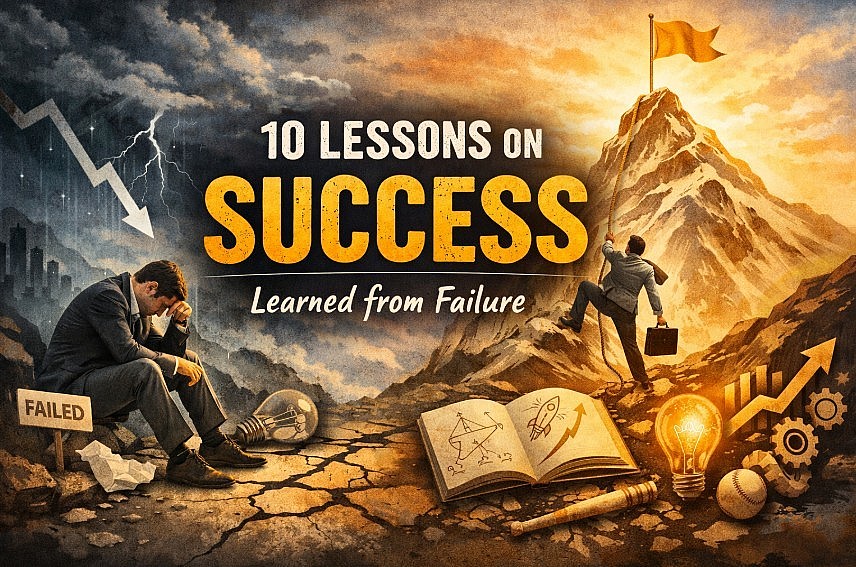 |
| Lessons on Success Learned from Failure |
Behind every achievement is a trail of mistakes, setbacks, and moments when giving up feels easier than continuing. Many people stop at that point. They let disappointment define them, and failure becomes a cycle.
But it doesn’t have to be that way.
Failure, when understood correctly, is not an ending. It’s raw material. It’s feedback. It’s a foundation. The people we admire most didn’t avoid failure. They used it.
Think about Thomas Edison, who reportedly went through thousands of unsuccessful attempts before creating a working light bulb. He didn’t see those attempts as defeats, but as lessons.
Here are 10 powerful lessons failure can teach you on the path to success.
1. Accept Failure, But Never Stop Trying
Michael Jordan once said he could accept failure, but not the lack of effort.
That idea matters. Failure is part of trying. Not trying is choosing to stay stuck.
When you accept failure as part of the process, it loses its power over you. It becomes something you move through, not something that stops you.
2. Keep Moving Forward, No Matter What
Before building an empire, Walt Disney was fired for “lacking imagination.”
That rejection didn’t define him. His response did.
People will doubt you. Circumstances will slow you down. But progress belongs to those who keep going anyway.
3. Persistence Turns Failure Into Progress
Baseball legend Babe Ruth understood that every missed swing brings you closer to a hit.
Failure isn’t separate from success. It’s part of the same process. Each attempt gives you data. Each mistake refines your approach.
If you keep going, failure becomes movement, not stagnation.
4. Sometimes Failure Means You Need a New Direction
The founders of Ben & Jerry’s didn’t start out successful. One dropped out of school. The other failed to get into medical school.
Instead of forcing a path that wasn’t working, they pivoted.
Failure can be a signal. Not to quit entirely, but to adjust. Sometimes the goal stays the same, but the path changes.
5. Believe in Yourself, Even When Others Don’t
Elvis Presley, Lucille Ball, and Carol Burnett were all told they didn’t have what it takes.
They didn’t listen.
External doubt is common. Internal doubt is optional. The difference between those who succeed and those who don’t often comes down to self-belief.
6. Failure Is a Chance to Learn and Improve
Henry Ford described failure as an opportunity to begin again, but more intelligently.
That’s the key. Failure only helps if you reflect on it.
Ask simple questions:
- What went wrong?
- What can I do differently?
- What did this teach me?
Learning turns failure into leverage.
7. Your Attitude Toward Failure Changes Everything
Winston Churchill defined success as moving from failure to failure without losing enthusiasm.
During World War II, Britain faced enormous setbacks. What made the difference wasn’t the absence of failure, but the refusal to lose belief.
Your mindset determines whether failure weakens you or strengthens you.
8. Courage Is Non-Negotiable
Mary Pickford believed failure isn’t falling down, but refusing to get back up.
Courage doesn’t mean you’re not afraid. It means you act anyway.
Every time you continue after a setback, you build resilience. That resilience becomes a competitive advantage over time.
9. Don’t Quit—Find Another Way
Mary Kay Ash once said that for every failure, there’s an alternative path.
Sometimes the obstacle isn’t the end. It’s just a signal to try a different approach.
When one strategy fails, don’t abandon the goal. Adjust the method.
10. Success Is Built on Failure
Benjamin Disraeli openly stated that his successes were built on his failures.
That’s not unusual. It’s the pattern.
Without failure:
- You don’t adapt
- You don’t grow
- You don’t gain experience
Failure is not the opposite of success. It’s the groundwork.
Final Thought
Failure is unavoidable. But wasted failure is optional.
If you let it stop you, it becomes an ending. If you learn from it, it becomes momentum.
The real question isn’t whether you’ll fail. You will.
The question is what you’ll do next.