2026 NFL Mock Draft Roundup: 10 Sleepers Quietly Climbing Boards

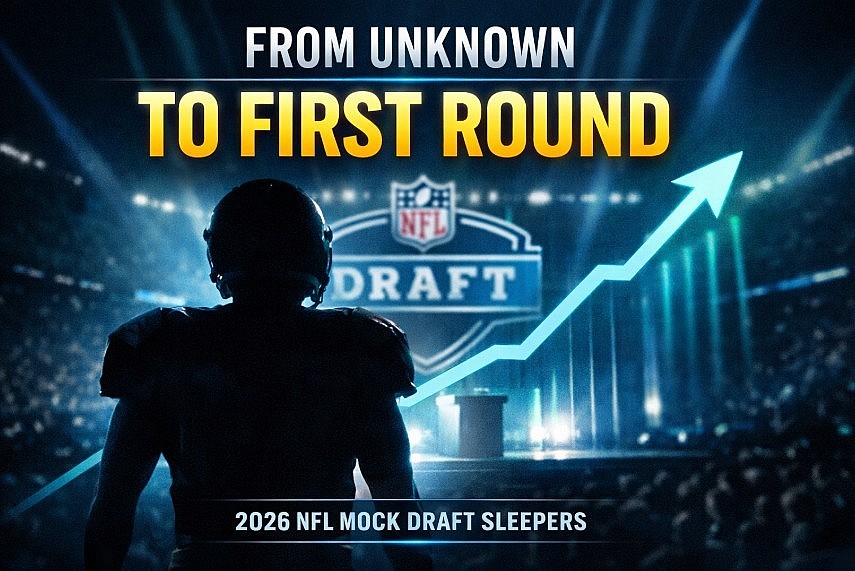 |
| From Unknown to First Round |
Early 2026 NFL mock drafts have already settled into a familiar rhythm: quarterbacks at the top, the same handful of blue-chip names in every projection, and team needs that read like a copy-paste job.
But if you want to be right more than you want to be early, you track the players who are moving. The prospects who aren’t consensus top-10 picks in December, then suddenly become first-round conversation by March.
This roundup is built around that idea: sleepers who are gaining real traction in early mocks, big boards, and “under-the-radar” first-round projections — plus the NFL teams that fit them best, using the current projected 2026 draft order as the backbone.
Read more: Top 8 Most Dangerous Potential Wild-Card Teams Entering NFL Week 18
What counts as a “sleeper” in the 2026 NFL Draft?
Not a random Day 3 dart throw. In this context, a sleeper is typically one of these:
-
A player outside the most common top-10 conversation who shows up as a surprise Round 1 candidate in at least one credible mock
-
A prospect with NFL traits that pop on film (speed, leverage, separation, processing) but isn’t a mainstream name yet
-
A player whose value is scheme-dependent (meaning: the public underrates them until the right team fit becomes obvious)
That’s why this list leans on prospects already appearing in early 2026 mock coverage and rankings — not invented “hidden gems.”
The early draft order shapes everything
As of the most recent ESPN projection, the teams at the top include Raiders, Jets, and Giants, followed by other QB-needy or roster-reset franchises. That matters because early-round chaos usually starts with quarterbacks, then ripples into unexpected skill-position and defensive value picks.
10 Sleeper Prospects Rising (and where they fit)
1) Jordyn Tyson, WR, Arizona State
Why he’s rising: Some early “under-the-radar” Round 1 mocks have already plugged Tyson into the top of the draft, which is exactly how sleeper momentum begins: one outlet goes first, others double-check the tape, and suddenly he’s a “fast riser.”
Best team fits:
-
New York Giants: A route-winner who can separate consistently is a clean match for an offense trying to stabilize.
-
Cleveland Browns / Washington Commanders: If you’re building around QB development, “gets open” is the most bankable receiver trait.
2) Carnell Tate, WR, Ohio State
Why he’s rising: Tate is being mocked high in multiple early projections, and team-focused draft coverage has started flagging him as a polished target who checks a lot of “NFL-ready” boxes.
Best team fits:
-
Browns: A pro-ready WR who can contribute early.
-
Giants: If the plan is to support the QB (whoever it is), Tate fits the “reliable chain-mover” mold.
3) Arvell Reese, LB, Ohio State
Why he’s rising: Reese is showing up high in first-round mocks, including in projections that treat him as a premium defensive centerpiece rather than a “linebacker value pick.”
Best team fits:
-
Tennessee Titans: Some mocks already connect Reese to Tennessee near the top of the round.
-
Washington Commanders: A modern LB who can anchor the middle is an instant defensive identity pick.
4) Rueben Bain Jr., EDGE, Miami
Why he’s rising: Bain is appearing as a top-edge option in early mock scenarios, including in top-10 ranges where casual fans often expect only “household” defenders.
Best team fits:
-
Arizona Cardinals: Edge help is always premium, and mocks have already linked Bain there.
-
Any defense that needs pressure without blitzing: Bain’s value jumps if a coordinator wants four-man pressure to carry the system.
Read more: NFL Week 18 Scenarios Explained: Every Game That Decides Playoff Seeding
5) Caleb Downs, S, Ohio State
Why he’s on a sleeper list: Downs is a big name to draft nerds, but safeties rarely get “top five” respect publicly. Early mocks putting him that high is the sleeper angle: positional value vs. actual board value.
Best team fits:
-
Tennessee Titans: Some early first-round projections already tie Downs to Tennessee.
-
Any defense that lives in split-safety looks: If your coverage structure demands range and instincts, elite safety play changes everything.
6) Francis Mauigoa, OT (flex), Miami
Why he’s rising: Draft coverage is already framing Mauigoa as a physically dominant lineman with guard/tackle flexibility, and that versatility is exactly what causes late-cycle risers.
Best team fits:
-
Giants: If you’re rebuilding an offense, you build the line first.
-
Jets: If their draft slot stays near the top, protection and stability become non-negotiable.
7) Chris Bell, WR, Louisville
Why he’s rising: Even as a Day 2 projection, he’s already being highlighted as a riser with the size/burst profile that can jump into Round 1 conversations by combine season.
Best team fits:
-
Steelers: If they’re hunting WR help in mocks, a size/speed boundary target fits their historical preferences.
-
Any team needing explosive plays without forcing 50/50 balls: Bell’s appeal is upside plus trackable traits.
8) Mansoor Delane, CB, LSU
Why he’s rising: Corners with “first-round athleticism” often climb once teams start building match-specific coverage plans in evaluation meetings. Delane is already being framed in that bucket.
Best team fits:
-
Teams that play man coverage (or want the option): athletic corners become premium chess pieces.
-
Contenders picking late: CB is one position where “best player available” actually makes sense.
9) David Bailey, EDGE, Texas Tech
Why he’s rising: Similar to Delane — already tagged as having first-round traits that could catapult him up boards by March. That’s the exact sleeper timeline.
Best team fits:
-
Teams that want speed off the edge: Bailey’s value jumps if a defense prioritizes get-off and disruption.
-
Playoff teams: late first-round edge picks are how good defenses stay good.
10) The QB2/QB3 debate effect (why it creates “accidental” sleepers)
The top of the 2026 board is already centered on Dante Moore and Fernando Mendoza in multiple national outlets, and that QB gravity pushes other prospects into weird spots early — then they rebound hard as the cycle matures.
Translation: even if you don’t love a specific QB class, the early QB run often creates bargain value at WR, EDGE, OT, and CB — and that’s where sleepers turn into “why didn’t we see this earlier?” picks.
Conclusion
Early 2026 NFL mock drafts are useful for setting the table, but they rarely tell the full story. The players who ultimately shape a draft class are often the ones who rise quietly — the prospects whose traits, consistency, and fit matter more to NFL teams than early-season hype.
This draft cycle is already showing familiar patterns. Quarterback movement is influencing the top of the board. Positional value is pushing certain players down in public mocks. Meanwhile, front offices are doing what they always do: prioritizing role fit, versatility, and long-term projection.
That’s where sleepers emerge.
By the time the 2026 draft arrives, several names currently labeled as “under-the-radar” will be viewed as logical, even obvious, first-round picks. The surprise won’t be that they went early. The surprise will be how long it took the conversation to catch up.