How Big Is Iran Compared With the US, Israel, and Iraq? Size, Maps, and Key Facts

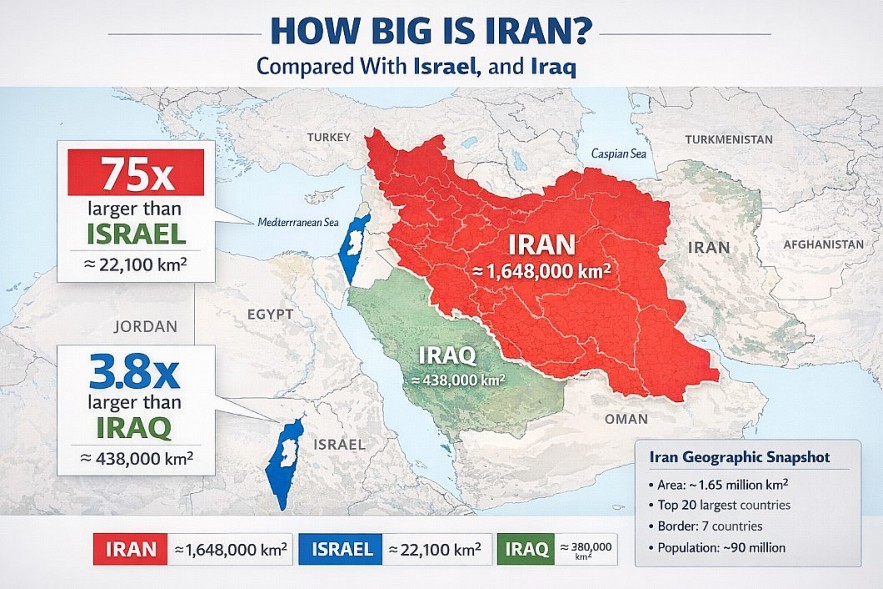 |
| Iran vs Israel vs Iraq – size comparison map |
Why Iran’s Size Matters
Iran is one of the largest and most geographically significant countries in the Middle East. Yet many people underestimate just how large it is, especially when compared with nearby states such as Israel and Iraq or global powers like the United States.
With a total area of about 1.65 million square kilometers, Iran ranks among the top 20 largest countries in the world and is the second-largest country in the Middle East.
Its size shapes nearly every aspect of its national power, from military strategy and economic resources to geopolitics and infrastructure. In regional conflicts or strategic planning, geography is a major factor.
This article provides a clear comparison of Iran’s size relative to the United States, Israel, and Iraq, supported by data tables, visual explanations, and infographic ideas to help readers quickly grasp the scale differences.
Read more: Inside Iran’s Nuclear Fortress Fordow: The Truth About the Mountain-Deep Centrifuge Halls
Iran at a Glance
Before comparing Iran to other countries, it helps to understand its basic geographic profile.
Quick facts about Iran
| Category | Data |
|---|---|
| Total area | ~1,648,195 km² |
| Land area | ~1,531,595 km² |
| Population | ~90+ million |
| Global size rank | Top 20 worldwide |
| Region | Middle East / West Asia |
| Capital | Tehran |
Iran borders seven countries, including Iraq, Turkey, Afghanistan, Pakistan, and Armenia, while also touching the Persian Gulf, Gulf of Oman, and the Caspian Sea.
Its large territory contains mountains, deserts, fertile plains, and major energy reserves, giving it strategic depth compared with many neighboring states.
Read more: Nuclear Sites in Iran: Latest Discoveries, Strategic Threats & Military Options
Iran vs. The United States: A Giant vs. a Superpower
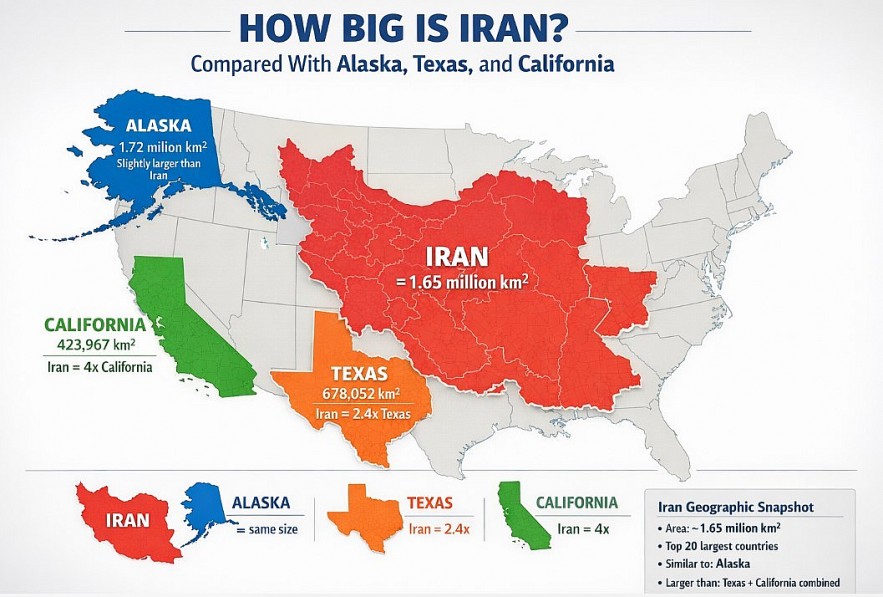 |
| Iran’s territory is roughly the same size as Alaska, about 2.5 times the size of Texas, and around four times California |
At first glance, comparing Iran with the United States might seem unfair. The US is one of the largest countries in the world. Yet the comparison still reveals useful perspective.
Total Land Area Comparison
| Country | Total Area |
|---|---|
| United States | ~9,833,520 km² |
| Iran | ~1,648,195 km² |
Key takeaway:
Iran is about one-sixth the size of the United States.
That means the US is roughly six times larger than Iran in total territory.
Iran Compared With US States
A clearer way to visualize Iran’s size is to compare it with individual US states.
Examples
| Comparison | Result |
|---|---|
| Iran vs Alaska | Roughly similar in size |
| Iran vs Texas | Iran ≈ 2.5× larger |
| Iran vs California | Iran ≈ 4× larger |
Iran’s landmass is roughly equivalent to Alaska, the largest US state.
If placed on a US map, Iran would stretch across multiple states, covering territory from the East Coast deep into the Midwest.
Population Comparison
| Country | Population |
|---|---|
| United States | ~335 million |
| Iran | ~90 million |
Even though Iran is smaller geographically, it still has a large population base, ranking among the world’s most populous countries.
Why the US–Iran Size Comparison Matters
Iran’s scale means it cannot be easily compared to smaller Middle Eastern states. For example:
-
Long borders increase defensive complexity
-
Diverse terrain complicates military operations
-
Internal transport networks span thousands of kilometers
Military analysts often point out that Iran’s size alone would make any large-scale invasion extremely difficult, similar to challenges faced in Iraq or Afghanistan but on a larger scale.
Iran vs Israel: One of the Biggest Size Gaps in the Middle East
The size difference between Iran and Israel is dramatic.
Territorial Comparison
| Country | Area |
|---|---|
| Iran | ~1,648,195 km² |
| Israel | ~22,000 km² |
Iran is roughly 75 times larger than Israel.
This means Israel occupies just about 1.3% of Iran’s territory.
Population Comparison
| Country | Population |
|---|---|
| Iran | ~90 million |
| Israel | ~10 million |
Iran also has about nine times the population of Israel.
However, geography does not automatically translate into power. Israel compensates for its smaller size with:
-
advanced military technology
-
high economic productivity
-
strong alliances, especially with the United States
In contrast, Iran’s strength lies partly in strategic depth, population size, and geographic scale.
Visualizing the Size Difference
If Israel were placed inside Iran:
-
more than 70 Israels could fit inside Iran’s territory
-
Iran’s landmass would still have space left over
This stark difference helps explain why regional conflicts often involve long-distance missile or proxy warfare rather than direct territorial confrontation.
Iran vs Iraq: A Large Neighbor
Iran and Iraq share one of the Middle East’s most historically significant borders. The two countries fought the devastating Iran-Iraq War from 1980 to 1988, partly influenced by territorial and political tensions.
Land Area Comparison
| Country | Total Area |
|---|---|
| Iran | ~1,648,195 km² |
| Iraq | ~438,317 km² |
Iran is about 3.8 times larger than Iraq.
Population Comparison
| Country | Population |
|---|---|
| Iran | ~90 million |
| Iraq | ~40 million |
Iran also has more than double Iraq’s population.
Geographic Implications
Iran’s larger size gives it several strategic advantages over Iraq:
-
Greater natural resource diversity
-
More internal industrial capacity
-
Greater defensive depth
However, Iraq’s geography includes important oil fields and key river systems like the Tigris and Euphrates, which remain strategically vital.
Putting It All Together: Iran vs US, Israel, and Iraq
The following summary table makes the differences easier to understand.
| Country | Area (km²) | Relative Size vs Iran |
|---|---|---|
| United States | ~9,833,520 | ~6× larger |
| Iran | ~1,648,195 | Baseline |
| Iraq | ~438,317 | Iran ≈ 3.8× larger |
| Israel | ~22,000 | Iran ≈ 75× larger |
Why Iran’s Geographic Size Matters in Global Politics
Iran’s size influences several key geopolitical factors.
1. Strategic Depth
Large countries are harder to control or invade.
Iran’s territory includes:
-
major mountain ranges (Zagros, Alborz)
-
large deserts (Dasht-e Kavir, Dasht-e Lut)
-
long coastlines
These features create natural defensive barriers.
2. Energy Resources
Iran possesses some of the largest oil and natural gas reserves in the world. Large land area allows access to multiple energy basins across the country.
Energy infrastructure spans thousands of kilometers, connecting:
-
the Persian Gulf
-
the Caspian Sea region
-
inland production centers
3. Regional Influence
Iran’s geographic scale allows it to project influence across:
-
the Persian Gulf
-
Central Asia
-
the Caucasus
-
the Levant
This geographic reach helps explain Iran’s role in regional politics and conflicts.
Common Misconceptions About Iran’s Size
Misconception 1: Iran is similar in size to Middle Eastern neighbors
Reality:
Iran is far larger than most Middle Eastern states, except Saudi Arabia.
Misconception 2: Israel and Iran are geographically comparable
Reality:
Iran is dozens of times larger.
Misconception 3: Iraq and Iran are roughly equal
Reality:
Iran is almost four times larger.
The Bottom Line
Iran’s geographic size is one of the defining factors in Middle Eastern geopolitics.
Key takeaways:
-
Iran covers about 1.65 million km²
-
It is roughly one-sixth the size of the United States
-
It is about 3.8 times larger than Iraq
-
It is around 75 times larger than Israel
This scale provides Iran with significant strategic depth, natural resources, and regional influence.
Understanding these geographic realities helps explain why Iran plays such a central role in Middle Eastern politics and global security discussions.