How Canadians Can Find Cheap Flights This Expensive Summer: Border Trick, Timing, Surprising Twist

There’s a quiet frustration many Canadians feel when searching for flights in 2026. You open your laptop, type in a simple route like Toronto to Vancouver, and the number that pops up feels… disproportionate. Not outrageous, but not exactly inviting either.
If you’ve ever compared that price with a similar trip inside the United States, the difference becomes even more obvious. More routes, more competition, more airlines in the U.S. create a kind of invisible pressure that keeps prices in check. Canada, with its vast geography and fewer major carriers, plays by different rules.
And yet, cheap flights are still out there. You just have to approach the search differently this summer.
Read more: How to Find Cheap Flights This Expensive Summer: Airfare Hacks for U.S. Travelers
 |
| In Canada, cheap flights are harder to find because the market is smaller and less competitive |
Fewer Choices, Higher Stakes
Flying in Canada is not just about distance. It’s about structure.
Air Canada and WestJet still dominate much of the market. Newer or smaller players like Porter and Flair bring competition, but only on selected routes. When demand spikes or fuel prices rise, there aren’t always enough alternatives to keep fares low.
That’s why a smart Canadian traveller doesn’t just search once and book. They treat airfare like a moving target.
There’s a subtle shift in mindset here. Instead of asking, “What’s the cheapest flight today?”, you start asking, “What is a fair price for this route—and how long should I wait before it disappears?”
- Which is The Cheapest Place to Fly to From Each State in the US?
The Border Trick That Still Works
One of the most practical advantages Canadians have is geographic, not digital: proximity to the United States.
If you live in Southern Ontario, checking Buffalo or Detroit can sometimes save hundreds. Vancouver travellers occasionally benefit from Seattle. Montreal residents might look toward Plattsburgh or Burlington.
But here’s the honest truth: this is not a guaranteed hack anymore. With fuel costs rising and cross-border demand increasing, the gap has narrowed.
Still, when the savings are significant, it’s worth considering.
Travel Insight: When Crossing the Border Pays Off
Consider flying from a U.S. airport if:
• You save at least CA$200 per person
• The drive is under 3 hours
• You’re not traveling with tight schedules or young kids
• Parking and hotel costs don’t erase the savings
Timing Matters More Than Ever
In the past, people loved simple rules like “book on Tuesday.” That kind of advice feels outdated now.
What matters more is when you travel.
Late June and mid-July remain peak periods. Prices are high because demand is predictable. Families travel, schools are out, and international routes fill quickly.
Late August, on the other hand, has a different energy. Some travellers are heading home. Airlines start adjusting prices to fill remaining seats.
That’s where opportunity lives.
- Don’t Skip Long Layovers: A Smart Way to Save on International Flights
- Cheap Flights Aren’t Gone - Americans Are Still Finding Them in 10 Tips
Price Timing Box: A Simple Reality Check
July flights: High demand, limited discounts
Late August: Softer demand, more flexibility
Early September: Often the sweet spot for value + good weather
If your schedule allows even a small shift, you can feel the difference in price immediately.
Not All Cheap Fares Are Actually Cheap
This is where many travellers quietly lose money.
A CA$120 ticket looks like a win… until you realize it includes:
- No carry-on
- No seat selection
- High change fees
- A long layover
By the time you add what you actually need, the “cheap” fare may no longer be cheap.
There’s a certain maturity in travel planning that develops over time. You stop chasing the lowest number and start evaluating the full experience.
- Top 10 Best Websites to Book Cheap Flights in 2026
Smart Booking: What to Check Before You Click “Buy”
• Carry-on allowance (many ultra-low fares charge extra)
• Total travel time vs direct flights
• Seat selection costs
• Change or cancellation flexibility
• Airport transfer costs at your destination
Sometimes paying an extra CA$40 upfront saves you stress, time, and even money later.
A Practical Comparison: What Your Options Really Look Like
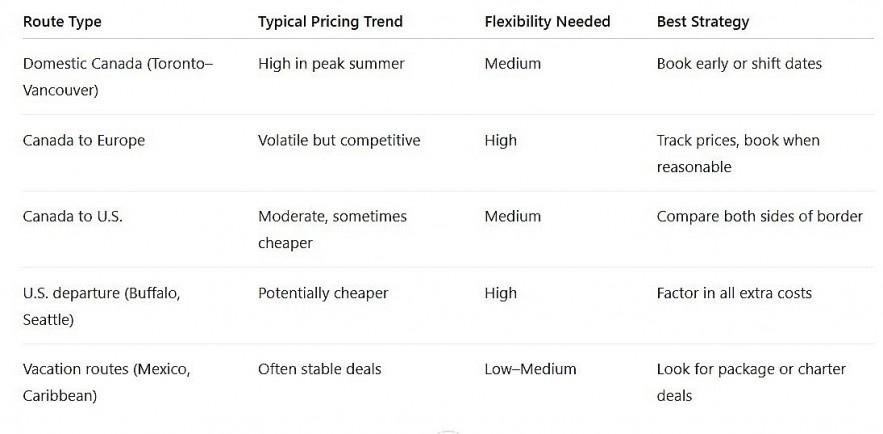 |
| This table tells a simple story: flexibility is not optional anymore. It’s the currency that buys you savings. |
Domestic vs International: A Surprising Twist
Here’s something that feels counterintuitive in 2026:
Some international flights can feel more “reasonably priced” than domestic ones.
Why? Because international routes often have more competition, especially to Europe and vacation destinations. Meanwhile, domestic routes remain more controlled.
That’s why a Toronto to Lisbon or Vancouver to Tokyo deal can occasionally feel like better value than a peak-date domestic flight.
This doesn’t happen every day, but when it does, it’s worth considering a different kind of summer.
The Quiet Power of Price Alerts
Many people set alerts and forget them. That’s a mistake.
In 2026, fares move fast. When a good deal appears, it doesn’t wait for you to think about it overnight.
Set alerts on Google Flights, KAYAK, or Hopper. But more importantly, act when the price feels right.
Not perfect. Not “the lowest ever.” Just right.
Final Thoughts: Think Like a Strategist, Not a Tourist
Cheap flights in Canada are not about luck. They’re about awareness.
You are navigating a smaller, more concentrated market than the United States. That means fewer mistakes are forgiven. But it also means informed travellers have a real edge.
If there’s one honest piece of advice I’d give, it’s this:
Do not wait for the perfect deal. Wait for a good one—and understand why it’s good.
That shift alone can save you money, time, and a lot of quiet frustration.