Top 10 Largest Cities in the United States by Population (2026)

In this article, KnowInsiders rank the top 10 largest U.S. cities by population (2026), highlighting key trends shaping urban growth, migration, and economic power across the country
Read more: Top 25 Largest Cities in the U.S. by Population in 2025
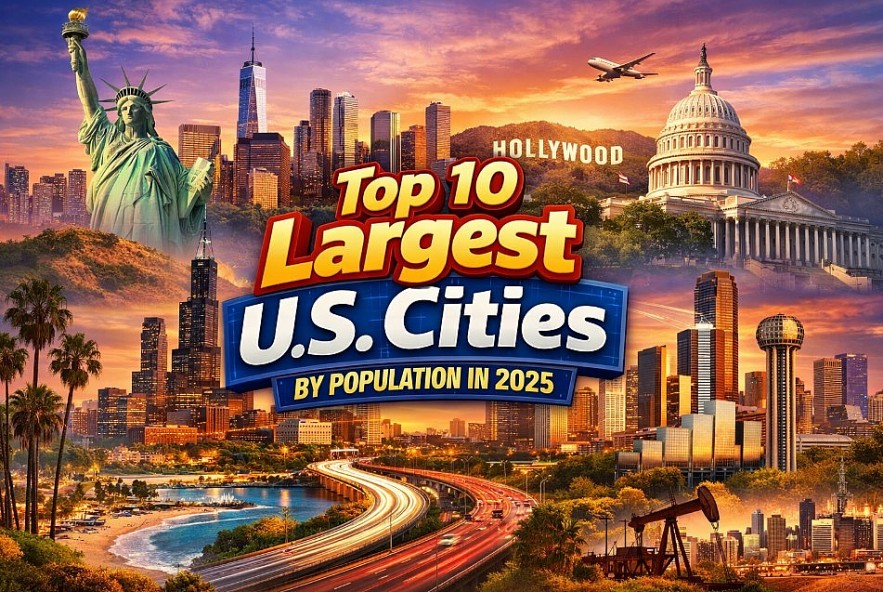 |
| 10 Largest Cities in the United States by Population |
1. New York City
Population (2025): ~13.9 million
New York City remains the most populous city in the United States and one of the most important metropolitan economies in the world. As a global center for finance, media, fashion, and technology, NYC generates immense economic output and cultural influence.
While the city has seen modest population declines since 2020 due to domestic migration to states like Florida and Texas, international immigration and high-value industries continue to sustain its long-term importance.
Read more: Top 10 Largest Cities in New York State: Population & Growth Insights
2. Los Angeles
Population (2025): ~12.7 million
Los Angeles is the second-largest city in the U.S. and the largest city in California. Best known as the heart of the global entertainment industry, LA also plays a major role in international trade, manufacturing, aerospace, and technology.
Unlike some other large U.S. cities, Los Angeles has added nearly 250,000 residents since 2020, supported by steady job growth and its position as a Pacific Rim gateway.
3. Houston
Population (2025): ~3.96 million
Houston is the largest city in Texas and one of the fastest-growing major cities in the country. Historically associated with energy and oil, Houston has diversified into healthcare, life sciences, logistics, and aerospace.
Affordable housing, a strong job market, and a business-friendly environment continue to draw new residents from across the U.S.
4. Chicago
Population (2025): ~3.68 million
Chicago is the largest city in the Midwest and a critical transportation and financial hub. Its central location makes it a cornerstone of U.S. rail, aviation, and freight networks.
The city’s economy spans finance, healthcare, advanced manufacturing, and education, anchored by world-class universities and a diversified corporate base.
5. Washington, D.C.
Population (2025): ~3.27 million
Washington, D.C. is unique among U.S. cities due to its role as the nation’s capital. Government, public policy, defense, and international diplomacy dominate the local economy.
Beyond politics, the metro area benefits from a highly educated workforce and stable employment, making it one of the most resilient large urban economies in the country.
6. Philadelphia
Population (2025): ~2.1 million
Philadelphia blends deep historical significance with a modern, knowledge-driven economy. The city is a national leader in healthcare, higher education, and life sciences.
Its location along the Northeast Corridor provides strong connectivity to New York City and Washington, D.C., reinforcing its long-term economic relevance.
7. Phoenix
Population (2025): ~1.8 million
Phoenix has become one of the fastest-growing large cities in the United States. Rapid expansion in semiconductor manufacturing, technology, and logistics has fueled job creation.
Combined with a relatively low cost of living and a warm climate, Phoenix continues to attract both businesses and new residents at a rapid pace.
8. San Antonio
Population (2025): ~1.6 million
San Antonio is one of the fastest-growing cities in Texas, supported by a strong military presence, tourism industry, and expanding healthcare sector.
Its young population and steady economic growth make it a key contributor to Texas’s broader demographic momentum.
9. San Diego
Population (2025): ~1.4 million
San Diego is a major coastal city known for its high quality of life and innovation-driven economy. Biotechnology, defense, and research institutions play a central role in local growth.
Its strategic location near the U.S.–Mexico border also strengthens its importance in cross-border trade and international collaboration.
10. Dallas
Population (2025): ~1.3 million
Dallas closes out the top 10 as one of the most dynamic business hubs in the southern United States. The city has benefited from corporate relocations, strong population growth, and a favorable tax environment.
Finance, technology, real estate, and logistics continue to drive Dallas’s expanding urban footprint.
Key Takeaways
-
New York City and Los Angeles remain dominant despite regional population shifts.
-
Texas cities such as Houston, San Antonio, and Dallas are gaining population faster than most coastal metros.
-
Sun Belt growth in cities like Phoenix reflects broader migration trends tied to affordability and job creation.
As of 2026, these ten cities represent the core of urban growth, economic power, and demographic change in the United States.