Top 10 Longest Words in English: Meanings, Origins, and Fascinating Language Facts

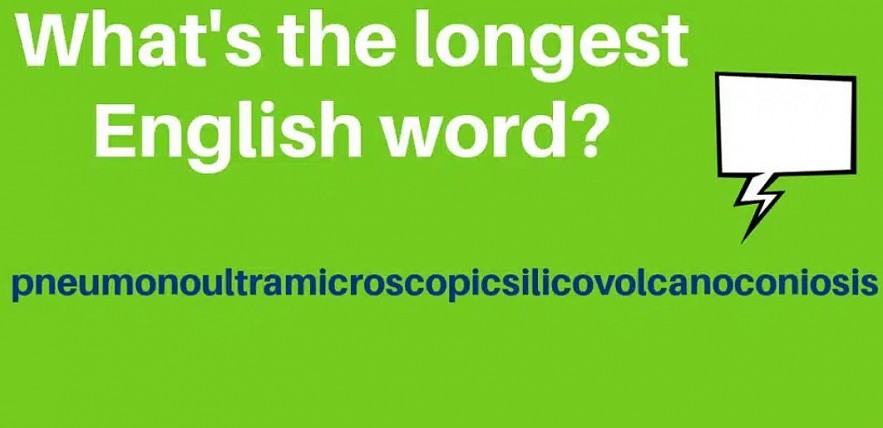 |
| Although pneumonoultramicroscopicsilicovolcanoconiosis is in the dictionary, it's not really a real word |
English is often praised for its simplicity and flexibility, yet it also contains words so long they seem almost impossible to pronounce. These extreme words come from science, politics, literature, and even humor. Some were created for technical accuracy, others to entertain, and a few simply to test the limits of language.
In this article, we explore the top 10 longest words in the English language, along with clear explanations of what they mean, where they come from, and how they are used.
What Defines the “Longest Word” in English?
There is no single official authority that decides the longest word in English. Linguists usually consider several criteria:
-
Inclusion in major dictionaries
-
Legitimate usage in medicine, science, politics, or literature
-
Whether the word functions as a real word rather than a formula
-
Frequency of citation and recognition
The list below includes widely accepted, well-documented words commonly referenced in linguistic and educational sources.
Read more:
- Full List of the New English Words in 2025 With Meanings And Usage
- Top 30+ Weirdest and Rarest Words In English Language
Top 10 Longest English Words (With Meanings and Context)
1. Pneumonoultramicroscopicsilicovolcanoconiosis (45 letters)
Meaning: A lung disease caused by inhaling extremely fine silica or volcanic dust.
Context: Often cited as the longest word in English dictionaries. It was intentionally coined in the 1930s to demonstrate linguistic length rather than medical practicality.
2. Hippopotomonstrosesquippedaliophobia (36 letters)
Meaning: The fear of long words.
Context: A humorous and ironic construction, commonly used as a linguistic joke rather than a clinical diagnosis.
3. Supercalifragilisticexpialidocious (34 letters)
Meaning: A playful expression meaning something is exceptionally good.
Context: Popularized by the movie Mary Poppins. It is an invented word created for entertainment.
4. Pseudopseudohypoparathyroidism (30 letters)
Meaning: A genetic disorder resembling hypoparathyroidism without actual hormone deficiency.
Context: A legitimate medical term used in endocrinology.
5. Floccinaucinihilipilification (29 letters)
Meaning: The act of regarding something as worthless.
Context: Rare in everyday speech but often cited in academic and linguistic discussions.
6. Antidisestablishmentarianism (28 letters)
Meaning: Opposition to removing state support from the Church of England.
Context: A political term from 19th-century Britain and one of the most famous long English words.
7. Honorificabilitudinitatibus (27 letters)
Meaning: The state of being able to achieve honors.
Context: Appears in Shakespeare’s Love’s Labour’s Lost and is often referenced in literary studies.
8. Incomprehensibilities (27 letters)
Meaning: Things that cannot be understood.
Context: One of the longest non-technical plural nouns in standard English dictionaries.
9. Psychoneuroendocrinological (27–28 letters)
Meaning: Relating to the interaction between psychological, neurological, and hormonal systems.
Context: Used in scientific research studying mind-body connections.
10. Hepaticocholangiogastrostomy (28 letters)
Meaning: A surgical procedure connecting the liver, bile ducts, and stomach.
Context: A highly technical medical term used almost exclusively in surgical literature.
Is There a Longer Word Than These?
Yes - technically.
The full chemical name of the protein titin contains over 180,000 letters, making it the longest word ever recorded. However, it is a chemical description rather than a functional word, so linguists generally exclude it from standard English word lists.
Why Does English Have Such Long Words?
Long English words usually exist for three main reasons:
• Scientific precision – especially in medicine and chemistry
• Historical and political complexity – requiring detailed terminology
• Playfulness and creativity – showing the flexibility of language
These words demonstrate how English can expand to describe even the most complex ideas.
Final Thoughts
You may never use these words in daily conversation, but they reveal a fascinating side of English. From medical terminology to playful inventions, long words show how language evolves to meet intellectual, cultural, and creative needs.
Understanding them is not about memorization, but about appreciating the depth and adaptability of English.
FAQs
What is the longest word in the English dictionary?
Most dictionaries list pneumonoultramicroscopicsilicovolcanoconiosis as the longest recognized English word.
Is the longest word actually used in real life?
Rarely. Many long words exist more for demonstration, education, or humor than daily communication.
Is “supercalifragilisticexpialidocious” a real word?
It is a coined word popularized by film. While not technical, it is widely accepted in popular culture.
Why are many long English words medical terms?
Medical terminology combines Greek and Latin roots to describe conditions with extreme precision, resulting in long compound words.
Should English learners study these words?
They are not essential, but they are useful for understanding word formation, prefixes, and suffixes.