Top 11 Safest Countries in the World 2026: Where Stability Still Thrives

 Top 10 Most and Least Peaceful Countries in the World to Visit 2022/2023 Top 10 Most and Least Peaceful Countries in the World to Visit 2022/2023 Look at the full list of latest 'Global Peace Index' to know top 10 safest countries and most dangerous countries in the world for 2022/2023. |
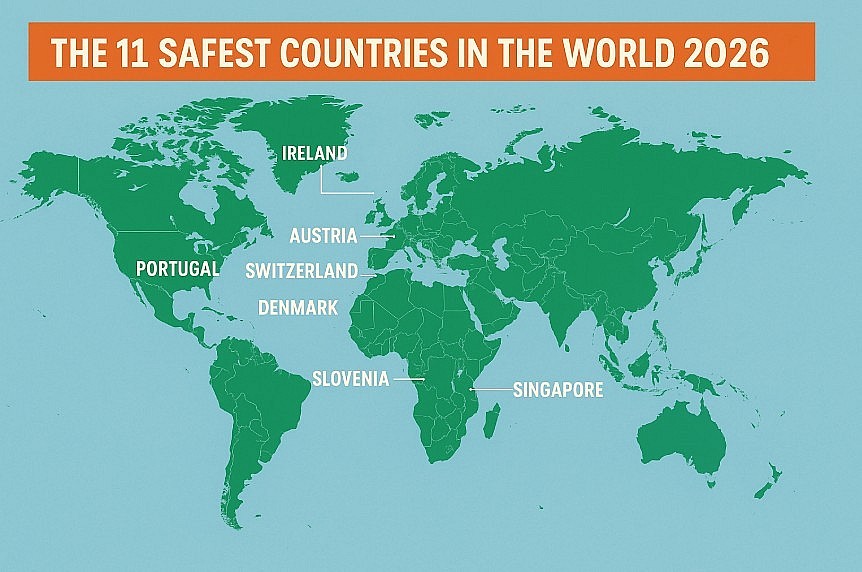 |
| The 11 Safest Countries in the World 2026 |
Safety has become a rare commodity. Wars continue in Ukraine and Gaza. Tensions rise across the Middle East. Conflict lingers in Syria. Global militarization is climbing, and economic pressures add even more volatility. Despite this backdrop, several countries maintain remarkably high levels of peace and stability.
Every year, the Global Peace Index (GPI), produced by the Institute for Economics and Peace, ranks 163 states and territories using 23 indicators across three categories: societal safety, ongoing conflict, and militarization. The 2025 report shows global peacefulness declining for the thirteenth time in fifteen years. Conflict deaths reached their highest level in decades, and 59 active state-based conflicts were recorded, the most since World War II.
Yet the same report also highlights nations that continue to thrive in peace. Western and Central Europe dominate the top positions, but a few outliers from Asia and Oceania stand strong as well.
The following list presents the 11 safest countriesin the world for 2026, based on the most recent GPI results and updated geopolitical insights.
1. Iceland
Iceland remains the world’s safest country, a position it has held for nearly two decades. Violent crime is almost nonexistent. Social trust is high, political disputes rarely escalate, and the country operates without a standing army. Its isolation, strong welfare systems, transparent institutions, and cohesive communities all play key roles in keeping Iceland peaceful.
2. Ireland
Ireland maintains its place near the top thanks to strong governance, low crime, and stable political conditions. Improvements in societal safety indicators and low levels of internal conflict continue to reinforce its ranking. Ireland’s combination of economic growth, cultural openness, and modern public services supports a secure environment for residents and visitors.
3. New Zealand
New Zealand’s peaceful reputation comes from low levels of violent crime, a robust democratic framework, and a long-standing commitment to civil liberties. While its geographic isolation offers natural protection, the country’s stability is rooted in well-managed institutions and a culture that values fairness and social equality. Even with occasional security adjustments in response to global threats, New Zealand remains consistently safe.
4. Austria
Austria scores highly for internal safety, political stability, and strong rule of law. Violent crime rates remain low, and the country maintains a carefully balanced approach to security and diplomacy. Austria’s neutrality has helped shield it from international tensions, while strong social welfare and efficient public services reinforce daily stability.
5. Switzerland
Known worldwide for its neutrality, Switzerland pairs political consistency with low crime, high incomes, and efficient governance. The country invests heavily in public infrastructure and social services, creating strong foundations for peace. Direct democracy gives citizens influence over policy decisions, helping maintain trust in government and reducing political friction.
6. Singapore
Singapore stands out as Asia’s safest country and one of the most secure urban societies in the world. Strict enforcement of laws, clean governance, and a world-class economy contribute to its stability. Violent crime is rare, and societal cohesion remains strong. Despite its compact size and dense population, Singapore delivers consistent safety through effective planning and social discipline.
7. Portugal
Portugal’s rise in peace rankings reflects years of steady political stability and low crime. The country is known for social tolerance, relaxed lifestyles, and effective public administration. Economic reforms over the past decade have strengthened stability, and Portugal’s calm social atmosphere continues to attract retirees, remote workers, and long-term travelers.
8. Denmark
Denmark combines strong social welfare with high trust in institutions, low corruption, and inclusive policies. While the country saw a slight increase in militarization following regional tensions, its overall societal safety remains excellent. High standards of living, equality, and community cohesion help Denmark retain a top-ten position.
9. Slovenia
Slovenia is one of Europe’s quiet success stories. A small, efficient, and socially cohesive nation, it benefits from low crime, political stability, and steady economic performance. Its strategic location between Central and Southern Europe brings cultural diversity without significant conflict risk. Slovenia’s focus on education, sustainability, and responsible governance further support peace.
10. Finland
Finland returns to the top tier thanks to strong social trust, transparent governance, and low crime. The country’s history of neutrality ended with its recent NATO membership, but defense adjustments have not harmed its internal stability. Finland’s high ranking is supported by excellent public services, a resilient economy, and a culture that values fairness and safety. Frequent recognition as one of the happiest nations aligns with its peaceful character.
11. Czechia
Czechia climbs to 11th place with impressive improvements in safety and social stability. It maintains a strong economy, universal healthcare, and accessible education. As an EU and NATO member, Czechia benefits from regional security cooperation, yet retains a relatively low militarization score. Its cities remain safe, well-managed, and attractive to tourists, students, and expats. The nation’s steady political environment helps secure its place among the world’s safest.
Why These Countries Stand Out
A few themes explain why these nations consistently score well:
Strong governance
Effective institutions and low corruption reduce conflict and crime.
Social equality
Countries with smaller wealth gaps generally experience fewer social tensions.
Reliable justice systems
Transparent courts and accountable policing reinforce public trust.
Low militarization
Most top-ranking nations invest more in social services than in military expansion.
Cultural cohesion
Shared values and social trust lead to fewer internal conflicts.
Stable economies
Financial stability supports peace and reduces the risk of unrest.
These factors show that peace is rarely accidental. It grows from deliberate choices, sustained policies, and cultural habits that prioritize cooperation over confrontation.
A Look at Global Trends for 2026
The gap between the safest and least safe countries keeps widening. Nations in Europe, Oceania, and parts of Asia continue to perform well, while conflict-prone regions such as the Middle East and sub-Saharan Africa struggle with instability.
Militarization is increasing worldwide, and geopolitical tensions remain high. Even so, the top-ranking nations prove that peace can be maintained when governance, social structures, and public trust work together.
For travelers, students, families, and investors, these countries offer secure environments and reliable long-term prospects.
FAQs
1. What makes a country "safe" in the Global Peace Index?
A country’s safety is determined by 23 indicators measuring societal security, internal and external conflict, and the degree of militarization.
2. Does a high ranking guarantee personal safety?
No ranking can offer absolute guarantees, but a top position strongly reflects low crime, stable government, and a reliable social system.
3. Why do European countries dominate the list?
Europe benefits from strong democratic institutions, social welfare systems, low militarization, and high levels of trust among citizens.
4. Are non-European countries represented?
Yes. New Zealand and Singapore consistently appear among the world’s safest countries.
5. How often is the GPI updated?
The Global Peace Index is published once per year and reflects the latest available data.
Conclusion
Despite a world filled with conflict and unpredictability, the safest countries of 2026 show that peace is achievable and sustainable. From Iceland’s quiet landscapes to Singapore’s polished skyline, each of these nations blends social stability with strong governance and a commitment to public well-being.
For anyone seeking safety, opportunity, or a calm place to call home, these 11 countries remain the leading examples of what a peaceful future can look like.