Average US Annual Salary by Age: How Much Do Americans Really Earn at Each Stage?

 |
| Average salary in the US by age |
“How much should I be earning at my age?”
It’s one of the most common career questions in the U.S. Yet the answers online are often confusing, outdated, or based on vague “averages” that don’t reflect real workers.
To give a clear, trustworthy comparison, this article uses official earnings data from the U.S. Bureau of Labor Statistics (BLS).
The figures come from the Current Population Survey, which tracks median usual weekly earnings of full-time wage and salary workers. These are the most widely cited benchmarks for age-based income comparisons in the United States.
Read more:
- Minimum Wage Laws 2026: Can Employers Refuse to Raise Pay?
- Minimum Wage in 2026: Do Tipped Workers Get a Raise in Restaurants, Salons, and Service Jobs?
- Minimum Wage Increases in 2026: How Much More Workers Actually Earn Each Month
- Minimum Wage in 2026: Which U.S. States Are Raising Pay and Who Benefits
- Should I Change Jobs After the Minimum Wage Increase in 2026?
How this salary data works (important to know)
Before comparing yourself, here’s what these numbers represent:
-
Full-time workers only (typically 35+ hours per week)
-
Wage and salary income, not business profits or freelance income
-
Median earnings, not averages, which better reflect a “typical” worker
-
Weekly pay figures annualized by multiplying by 52 weeks
This approach avoids the distortion caused by extreme high earners and gives a more realistic baseline for comparison.
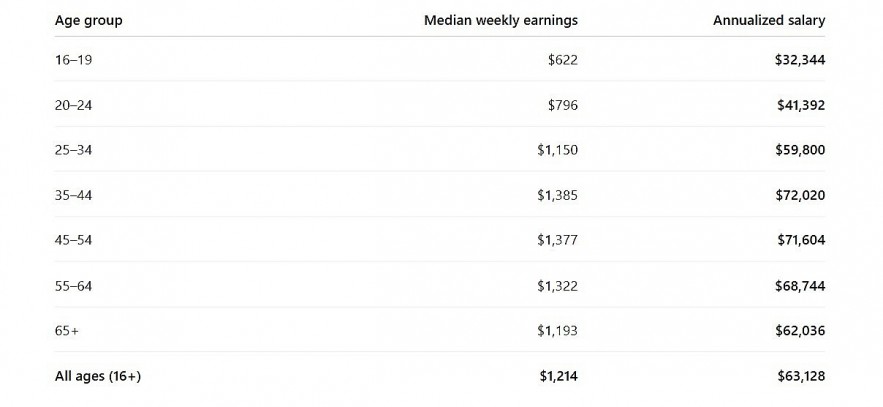
Average US annual salary by age (2025 estimates)
 |
| Average US annual salary by age |
Quick benchmark:
The typical full-time American worker earns about $63,000 per year, but income varies sharply by age.
What these numbers reveal about earning power
Your 20s: rapid growth, lower baseline
Workers aged 20–24 earn just over $41,000, reflecting entry-level roles, limited experience, and job switching. This is the fastest-growth phase of most careers.
Your 30s: the biggest jump
By 25–34, median annual pay rises to nearly $60,000. Many workers specialize, gain credentials, or move into higher-paying firms. Salary growth here is often faster than inflation.
Your 40s and early 50s: peak earning years
The 35–44 and 45–54 groups sit at the top, around $71,000–$72,000. These are typically senior individual contributor or management years, when experience and leverage are strongest.
Late career: stable, not collapsing
Earnings ease slightly after 55, but not dramatically. Even workers 65 and older still show a median annual income above $62,000, reflecting selective continued employment rather than full retirement.
Are you earning above or below average for your age?
Use this simple check:
-
Take your gross annual income (before taxes).
-
If hourly: hourly rate × hours/week × 52.
-
Compare to your age group’s median, not the national headline number.
Being below the median doesn’t mean you’re underpaid. It often reflects:
-
Lower cost-of-living regions
-
Early career stage within an age group
-
Industry-specific pay norms
Why “average US salary” headlines can mislead
Many articles quote a single national average salary. But age alone can swing expected earnings by $30,000+ per year. That’s why age-based benchmarks are far more useful for:
-
Career planning
-
Salary negotiations
-
Relocation decisions
-
Financial goal setting
Bottom line
The median full-time U.S. worker earns about $63,000 annually, with peak earnings typically occurring between ages 35 and 54. Comparing your income to people in the same age group gives a clearer, fairer picture than any one-size-fits-all “average salary” figure.
If you want a more precise comparison, the next step is layering in industry and location, where differences can be even larger than age alone.