Average US Annual Salary by State: Rankings, Real Pay Gaps, and What They Mean

 |
| Average US Annual Salary by State: Rankings, Real Pay Gaps, and What They Mean |
When Americans compare salaries, one truth shows up again and again: your state can matter almost as much as your job title.
According to the latest wage estimates from the U.S. Bureau of Labor Statistics (BLS), the gap between the highest-paying and lowest-paying states now exceeds $35,000 per year. That difference alone can shape where people choose to work, live, and retire.
Let’s break down where states actually rank, and what those rankings really mean for your money.
Read more: Average US Annual Salary by Age: How Much Do Americans Really Earn at Each Stage?
The national benchmark
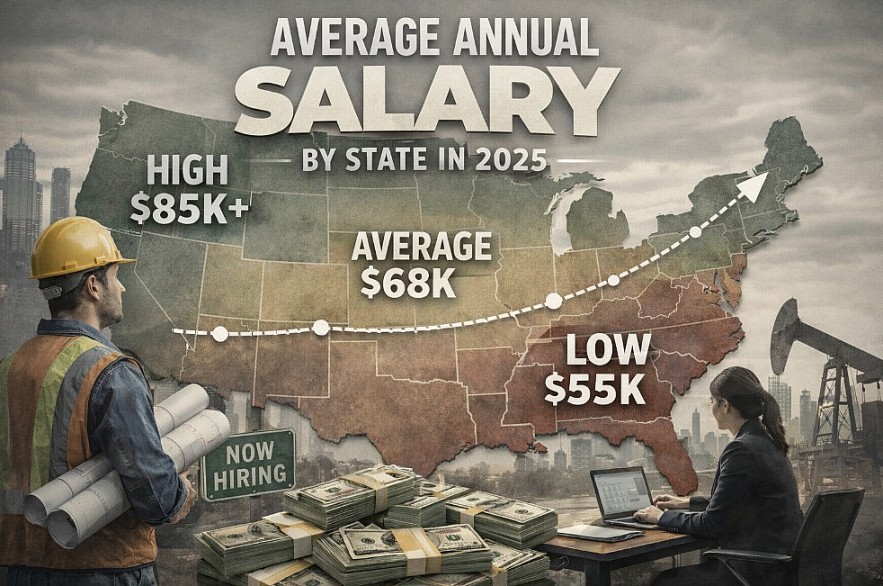
Across all occupations, the national average annual wage sits just under $68,000.
Think of this as the midpoint reference:
-
States above it tend to have high-skill, high-cost economies
-
States below it often trade lower wages for lower living costs
Top-paying states in the U.S.
These states consistently sit at the top of BLS wage rankings:
Washington
-
Average annual wage: ~$90,000+
-
Why so high: Technology, aerospace, cloud computing, engineering
-
Reality check: Housing costs are high, but many workers still net strong purchasing power.
California
-
Average annual wage: ~$85,000+
-
Why so high: Tech, entertainment, biotech, specialized healthcare
-
Reality check: Salary dispersion is extreme. Silicon Valley skews the average upward.
Massachusetts
-
Average annual wage: ~$83,000
-
Why so high: Education, biotech, healthcare, finance
-
Reality check: High salaries paired with high housing and tax pressure.
New York
-
Average annual wage: ~$82,000
-
Why so high: Finance, media, corporate headquarters
-
Reality check: NYC dominates the numbers. Upstate wages are far lower.
New Jersey
-
Average annual wage: ~$80,000
-
Why so high: Pharma, finance, corporate offices
-
Reality check: Proximity to NYC lifts wages statewide.
Pattern to notice:
Top-paying states are dense, urbanized, and dominated by industries that scale globally.
Middle-tier states: solid pay, better balance
These states hover close to the national average and often appeal to families and mid-career professionals:
-
Texas (~$68K–$70K)
-
Colorado (~$72K)
-
Virginia (~$74K)
-
Illinois (~$71K)
-
Minnesota (~$72K)
Why they matter:
Many offer a better salary-to-cost-of-living ratio than coastal states. Texas, for example, combines competitive wages with no state income tax.
Read more:
- Minimum Wage in 2026: Do Tipped Workers Get a Raise in Restaurants, Salons, and Service Jobs?
- Minimum Wage Increases in 2026: How Much More Workers Actually Earn Each Month
- Minimum Wage in 2026: Which U.S. States Are Raising Pay and Who Benefits
- Should I Change Jobs After the Minimum Wage Increase in 2026?
Lowest-paying states
States at the bottom of the ranking typically include:
-
Mississippi (~$52,000)
-
West Virginia (~$54,000)
-
Arkansas (~$55,000)
-
Alabama (~$56,000)
-
Louisiana (~$56,000)
This doesn’t mean workers are “paid unfairly.” It reflects:
-
Lower housing and daily costs
-
Fewer high-paying corporate roles
-
Greater concentration of lower-wage industries
In many rural areas, a lower salary still stretches further than a higher coastal paycheck.
Why state averages don’t tell the whole story
State-level averages hide massive differences within states.
For example:
-
California tech workers can earn 2× the state average.
-
Texas oil & gas engineers earn far more than retail or service workers.
-
Urban wages can exceed rural wages by $20,000–$30,000+ annually.
That’s why state salary data works best as a starting point, not a final judgment.
How Americans should use state salary rankings
Use this data strategically:
-
Compare your income to your state average, not the national number.
-
Ask whether your industry typically pays above or below the state mean.
-
Factor in housing costs and taxes before judging “better pay.”
A $75,000 salary in Ohio may offer more real freedom than $95,000 in coastal California.
Bottom line
In 2025, state lines still shape American paychecks. Washington, California, and Massachusetts lead the nation in average annual wages, while Southern states rank lower — often with lower costs to match.
The smartest question isn’t just “How much do Americans earn?”
It’s “How does my pay compare where I actually live?”