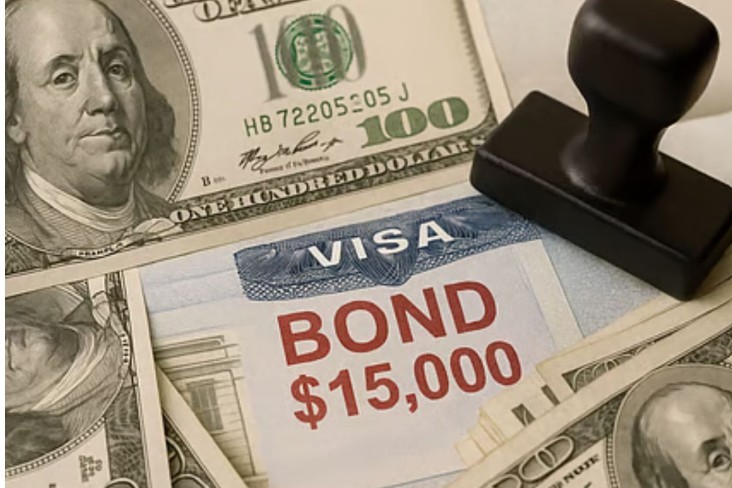
Full List: U.S. Widens $15,000 Visa Bond Rule to 38 Countries

 |
| The US has expanded its visa bond policy to 38 countries |
The United States has significantly broadened its controversial visa bond policy, now requiring citizens from 38 countries to post refundable deposits of up to $15,000 when applying for certain U.S. visitor visas — a move that takes effect on January 21, 2026. This expanded requirement, part of a series of Trump-era immigration and border control measures, includes new additions from Africa, Asia, and Latin America such as Bangladesh, Nepal and Bhutan.
What is the Visa Bond Requirement?
Under the expanded policy, certain applicants for B-1 (business) and B-2 (tourism) visas from the designated countries must post refundable bonds ranging from $5,000 to $15,000 during the visa application process. The bond amount is not a fixed fee; rather, consular officers determine the required amount case-by-case at the visa interview.
The purpose of these bonds, according to the U.S. State Department, is to discourage visa overstays and encourage compliance with visa terms. The bond is refundable if the visa is denied or if travelers comply with the visa conditions and depart the United States on time. However, paying the bond does not guarantee that a visa will be issued.
Read more: Full List of 13 Countries Facing Up to $15,000 U.S. Visa Bonds
Full List of the 38 Countries Subject to Visa Bonds
(With implementation dates where available, per the U.S. Department of State)
Countries and Implementation Dates
-
Algeria (January 21, 2026)
-
Angola (January 21, 2026)
-
Antigua and Barbuda (January 21, 2026)
-
Bangladesh (January 21, 2026)
-
Benin (January 21, 2026)
-
Bhutan (January 1, 2026)
-
Botswana (January 1, 2026)
-
Burundi (January 21, 2026)
-
Cabo Verde (Cape Verde) (January 21, 2026)
-
Central African Republic (January 1, 2026)
-
Côte d’Ivoire (Ivory Coast) (January 21, 2026)
-
Cuba (January 21, 2026)
-
Djibouti (January 21, 2026)
-
Dominica (January 21, 2026)
-
Fiji (January 21, 2026)
-
Gabon (January 21, 2026)
-
The Gambia (October 11, 2025)
-
Guinea (January 1, 2026)
-
Guinea-Bissau (January 1, 2026)
-
Kyrgyzstan (January 21, 2026)
-
Malawi (August 20, 2025)
-
Mauritania (October 23, 2025)
-
Namibia (January 1, 2026)
-
Nepal (January 21, 2026)
-
Nigeria (January 21, 2026)
-
São Tomé and Príncipe (October 23, 2025)
-
Senegal (January 21, 2026)
-
Tajikistan (January 21, 2026)
-
Tanzania (October 23, 2025)
-
Togo (January 21, 2026)
-
Tonga (January 21, 2026)
-
Turkmenistan (January 1, 2026)
-
Tuvalu (January 21, 2026)
-
Uganda (January 21, 2026)
-
Vanuatu (January 21, 2026)
-
Venezuela (January 21, 2026)
-
Zambia (August 20, 2025)
-
Zimbabwe (January 21, 2026)
This list includes pre-existing bond requirements for a subset of countries introduced in 2025, as well as 25 newly added nations that will enter the policy in early 2026.
How the Visa Bond Policy Works
Here is a step-by-step breakdown of the process:
-
Visa Application: Applicants from the listed countries apply for a B-1/B-2 visa at a U.S. embassy or consulate.
-
Interview and Bond Requirement: A consular officer assesses the application. If the officer determines a visa bond is required, they will specify the amount — typically $5,000, $10,000, or $15,000.
-
Form I-352 & Payment: Applicants must complete Department of Homeland Security Form I-352 and pay the bond through the U.S. Treasury’s Pay.gov portal only after being directed during the interview.
-
Visa Decision: The bond requirement is separate from the visa decision. A visa may still be approved or denied independently of bond payment.
-
Refund Conditions: If the visa is denied or the traveler abides by their authorized stay and departs on time, the bond is refunded.
Designated Ports of Entry
As part of compliance monitoring under the visa bond program, travelers who post bonds are required to use these three key U.S. entry ports:
-
Boston Logan International Airport (BOS)
-
John F. Kennedy International Airport (JFK)
-
Washington Dulles International Airport (IAD)
Failure to arrive through designated entry points may jeopardize compliance or affect refunds.
Rationale Behind the Expansion
Officials from the U.S. government assert that the policy aims to curb visa overstays, which they view as a persistent challenge in certain countries with historically high overstay rates. By requiring a financial guarantee, authorities intend to incentivize compliance with return dates and visa conditions.
However, critics — including immigration attorneys, rights groups, and global travel advocates — argue that the high bond amounts may act less as a compliance tool and more as a financial deterrent to legitimate travel. They point out that the bonds relative to average earnings in many of the affected countries (often well under $1,000 per month) could place U.S. travel beyond reach for many families and small-business visitors.
Who Is Affected and Who Is Not
-
Affected: Nationals of the 38 listed countries applying for B-1/B-2 visas (business or tourism) may face the bond requirement.
-
Not Affected: Citizens of countries in the U.S. Visa Waiver Program (42 nations) — including most of Europe, Japan, Australia, and others — are not subject to visa bonds because they do not need B-1/B-2 visas at all.
-
Exclusions: Visa bond rules do not apply to student visas (F and J), immigrant visas, or those under the Visa Waiver Program.
Importantly, Indian passport holders are not on the visa bond list, though travelers must still comply with standard U.S. visa procedures and interview requirements.
Implications for Travelers and Businesses
Financial Impact
The requirement of up to $15,000 per applicant can substantially increase the cost of travel. Families, entrepreneurs, and small business delegates from affected countries may find budget planning more difficult, especially for multiple travelers. Businesses planning short-term U.S. visits now need to factor bond costs into travel and mobility policies.
Visa Processing and Compliance
Because bonds are refundable, travelers who comply with departure terms can recoup their money. However, initial cash outlay — often a barrier — may discourage legitimate visits. Additionally, requirements for detailed background information and in-person interviews continue as part of broader visa policy tightening.
Criticism and Debate
-
Human rights and advocacy groups argue that large bond amounts act like de facto barriers to travel, penalizing citizens based on nationality rather than individual behavior.
-
Economists warn that such financial requirements could reduce business, tourism, and educational exchanges, especially from lower-income regions.
-
Policy defenders claim the bonds support U.S. national security and visa compliance by reducing overstays and unauthorized extensions.
Conclusion
The expansion of the U.S. visa bond policy to 38 countries represents one of the most impactful shifts in non-immigrant travel rules in recent years. Effective January 21, 2026, the policy may significantly affect how citizens from affected nations plan travel to the United States — both financially and logistically.
Travelers should prepare for bond requirements during visa interviews, ensure timely compliance to secure refunds, and seek guidance from official U.S. consular resources. For businesses, revising travel policies and budgeting for potential bond deposits will be essential in maintaining international mobility and compliance.