Julian Calendar 2026: Complete Guide to Holidays, Observances, Special Days and Celebrations
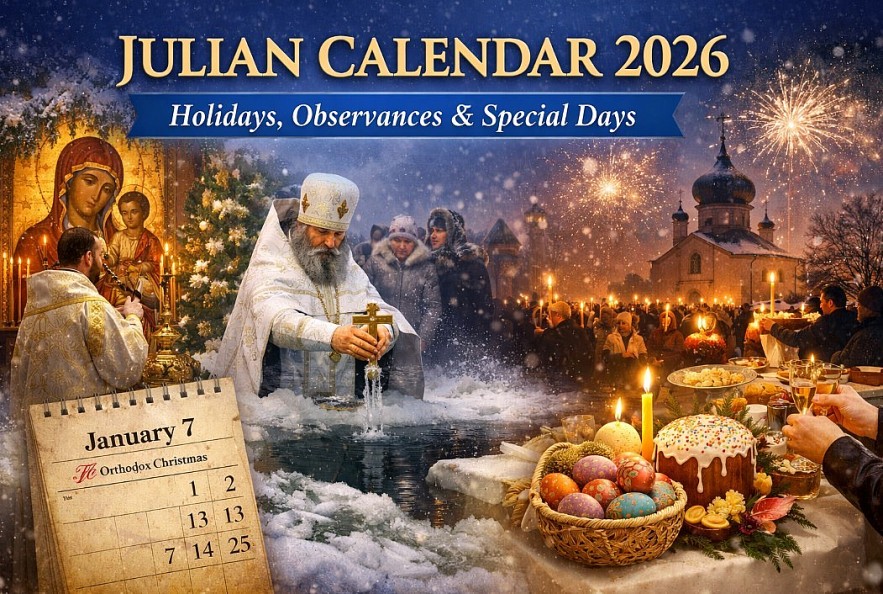 |
The Julian Calendar remains an important timekeeping system for millions of people worldwide, especially within Eastern Orthodox Christianity and communities that follow traditional “Old Style” dates. In 2026, the Julian calendar continues to guide religious holidays, cultural observances, and historical commemorations that differ from the modern Gregorian calendar used in most countries today.
This guide provides a clear and practical overview of the Julian Calendar 2026, including how it works, major holidays, notable observances, and why it still plays a meaningful role in modern life.
Understanding the Julian Calendar in 2026
The Julian calendar was introduced in 45 BCE and was widely used in Europe for centuries. Unlike the Gregorian calendar, which adjusted the length of the year to better match the solar cycle, the Julian system assumes a fixed year length. As a result, there is now a 13-day difference between the Julian and Gregorian calendars.
In practical terms, this means that dates in the Julian calendar fall 13 days later when converted to the Gregorian system in 2026. For example, January 1 on the Julian calendar corresponds to January 14 on the Gregorian calendar.
This difference is essential when tracking religious holidays, especially for Orthodox Christian churches that still follow the Julian calendar for liturgical purposes.
Major Julian Calendar Holidays in 2026
Many of the most important Julian calendar holidays are religious in nature. Below are some of the most widely observed celebrations in 2026, shown with their Gregorian equivalents for clarity.
Julian New Year (January 1 Julian / January 14 Gregorian)
Often called the “Old New Year,” this day is celebrated in parts of Eastern Europe, Russia, Serbia, and other regions with cultural ties to the Julian system. Traditions may include family gatherings, festive meals, and local customs.
Orthodox Christmas (December 25 Julian / January 7 Gregorian)
One of the most significant holidays in the Julian calendar, Orthodox Christmas is marked by church services, fasting periods, and traditional meals. It remains a deeply spiritual celebration for Orthodox Christians worldwide.
Epiphany (January 6 Julian / January 19 Gregorian)
This holiday commemorates the baptism of Jesus Christ. In many countries, it is associated with water-blessing rituals and public ceremonies, especially in colder regions where ice-water immersions are common.
Orthodox Easter (Pascha)
Orthodox Easter is the most important feast in the Julian liturgical year. Its date varies each year based on the Julian ecclesiastical calculation. In 2026, Pascha falls later than Western Easter, as is often the case. Celebrations include midnight services, candlelit processions, and traditional foods.
Important Observances and Fasting Periods
Beyond major feast days, the Julian calendar also structures long periods of observance and fasting.
Great Lent
The weeks leading up to Orthodox Easter are marked by fasting, prayer, and reflection. This period shapes daily life for many believers, influencing meals, social events, and religious attendance.
Nativity Fast
Observed before Orthodox Christmas, this fasting period prepares believers spiritually for the celebration of Christ’s birth.
Saints’ Days
Throughout the year, the Julian calendar marks numerous saints’ feast days. These are especially important in Orthodox cultures, where name days are often celebrated as much as birthdays.
Cultural and Historical Significance
While the Julian calendar is no longer used for civil purposes in most countries, its cultural importance remains strong. In 2026, it continues to serve as a link to history, tradition, and religious identity.
In some regions, public events, folk festivals, and local holidays still follow Julian dates. These occasions preserve customs that have been passed down for generations, offering a sense of continuity in a rapidly changing world.
The Julian calendar also plays a role in academic and historical studies, helping scholars accurately interpret historical documents, inscriptions, and events recorded before the adoption of the Gregorian calendar.
Why the Julian Calendar Still Matters in 2026
Despite being centuries old, the Julian calendar remains relevant. For religious communities, it defines sacred time. For cultural groups, it protects tradition. For historians, it provides essential context.
In 2026, understanding the Julian calendar is not just about dates. It is about respecting diverse ways of measuring time and recognizing how calendars shape belief, identity, and celebration.
Final Thoughts
The Julian Calendar 2026 offers a rich tapestry of holidays, observances, special days, and celebrations rooted in faith and history. Whether you follow it for religious reasons, cultural heritage, or personal interest, knowing its key dates helps you better understand traditions that continue to thrive alongside the modern calendar.