The California Anomaly: When $9 Gas Stops Feeling Impossible

You’re standing at a gas station in California, watching the numbers climb—$5, $6, sometimes higher depending on where you are. And even if it doesn’t hit $9 that day, the unsettling part is this: you can imagine it.
Not as a wild scenario. Not as a headline designed to shock. But as something that could just… happen.
That’s the shift.
In most of the US, high gas prices still feel temporary, something that will correct itself eventually. In California, that expectation has started to fade. Prices don’t just rise here—they behave differently.
And over time, people start adjusting not just their budgets, but their assumptions.
Read more: Why Gas Prices Rise Fast but Fall Slow? "Rockets and Feathers" Phenomenone
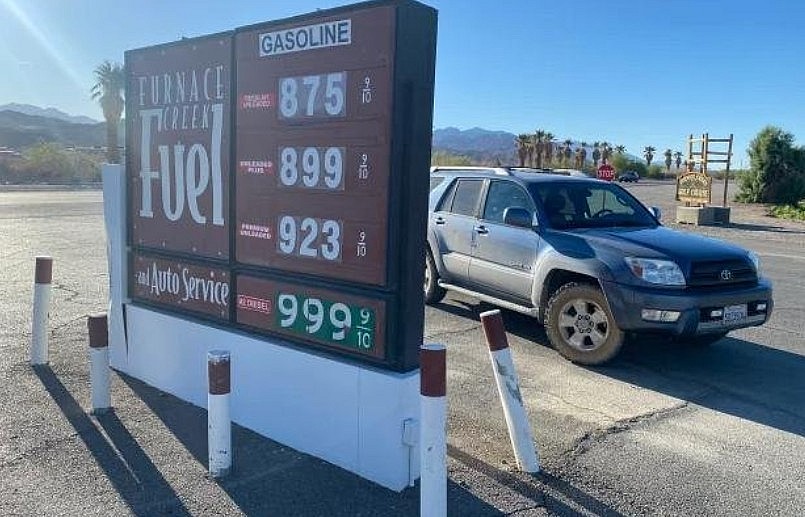 |
| Premium and diesel fuel prices exceed $9 per gallon at this gas station in Furnace Creek, |
It’s not just expensive. It’s structurally different.
It’s easy to say California gas is expensive because of taxes. That’s true, but it doesn’t fully explain the feeling people have when they pull into a station.
The California gas tax is part of it—higher excise taxes, environmental fees, cap-and-trade costs. Compared to places like Texas, where fuel policy is built around keeping prices low and supply flexible, California sits on the opposite end of the spectrum.
But what stands out isn’t just the price gap.
It’s how stubborn the prices are.
Even when oil markets cool off, California doesn’t relax in the same way. The drop is slower. The baseline stays higher. There’s a sense that once prices move up, they don’t really come back down to where they used to be.
And after a while, people stop expecting them to.
Read more: How $4 Gas Is Quietly Rewriting the US Supply Chain in 2026
Living on an energy island
There’s a phrase that comes up often when people try to explain this: refinery island.
At first, it sounds technical. But the reality is simple, and a bit unsettling.
California requires a special gasoline blend. Cleaner, better for air quality—but not widely produced outside the state. That means when something goes wrong locally—a refinery outage, maintenance delays, supply disruption—there isn’t an easy backup plan.
Other states can pull from each other. California can’t, at least not quickly.
So when supply tightens, prices react fast. And they don’t ease as quickly because the system itself is constrained.
It creates a kind of isolation. Not geographic, but infrastructural.
And that isolation is what makes extreme numbers like a $9 gas price feel less like an anomaly and more like a possibility waiting for the right conditions.
The quiet calculation people start making
At some point, high gas prices stop being a complaint and start becoming a calculation.
I remember talking to someone in Los Angeles who said they didn’t even look at the price anymore when filling up. Not because it didn’t matter, but because it always felt bad. Ignoring it was easier.
But later in the conversation, they mentioned something else.
They were thinking about switching to an electric vehicle.
Not out of excitement. Not because it felt futuristic. Just because they were tired of not knowing what gas would cost next month.
That’s the part that stays with you.
The shift toward EVs in California isn’t just about climate goals or incentives. It’s about predictability. When fuel prices become volatile and persistently high, stability becomes valuable.
That’s where the conversation around EV adoption vs gas prices becomes very real.
It’s no longer abstract. It’s personal.
When extremes become familiar
The first time people hear about gas approaching $7, $8, even $9, it feels shocking.
But California has a way of normalizing extremes.
Prices spike, people react, headlines follow. Then prices dip slightly—but not back to where they were before. And life continues.
After a few cycles, something changes.
The shock wears off.
You don’t like it. You don’t agree with it. But you adapt to it.
That’s how a number like $9 stops feeling impossible. Not because it happens every day, but because it fits within the range of what people have already experienced.
Read more: How $4 Gas Is Quietly Rewriting the US Supply Chain in 2026
A crisis, or a transition?
There’s an ongoing debate about whether this is a West Coast energy crisis or something else entirely.
From one angle, it looks like strain:
- High costs
- Limited supply flexibility
- Pressure on consumers
From another, it looks like transition:
- Aggressive environmental policies
- Rapid EV adoption
- A deliberate move away from fossil fuel dependence
Both are true.
California is trying to move forward while still living inside the current system. And that creates friction.
You feel it at the pump.
You feel it in your monthly expenses.
You feel it in the small decisions—drive or not, buy now or wait, switch or stay.
The emotional side no one really talks about
There’s also something quieter happening, something harder to measure.
Fatigue.
Not the kind that makes headlines, but the kind that builds slowly. The feeling of constantly adjusting, constantly recalculating, constantly absorbing small financial pressures.
You see it in how people talk:
- Less outrage, more resignation
- Less surprise, more expectation
And maybe that’s the most significant shift of all.
Because once people stop being surprised, the baseline has already moved.
What California reveals
California often feels like an outlier, but it’s also a signal.
It shows what happens when:
- Energy policy becomes more complex
- Supply systems become more constrained
- Consumers are pushed, gradually, toward alternatives
Not every state will follow the same path. But the forces at play—energy costs, environmental pressure, infrastructure limits—exist everywhere.
California just experiences them more intensely, and sooner.
Final thought
Standing at that gas station, watching the numbers climb, there’s a moment where you realize something has changed.
Not just the price.
Your expectation of what’s normal.
And once that shifts, everything else starts to follow.