The Vanishing Footprints: Reports of One-Way Tracks After Christmas Snowfalls






A Pattern Hidden in Winter Silence
On quiet winter mornings, especially right after Christmas, you expect certain things in mountain towns: smoke curling from chimneys, the crunch of ice, the stillness that comes before the sun warms the roads. But lately, in scattered parts of the U.S., residents are noticing something that feels out of place—footprints that appear to lead somewhere, yet never return.
These aren’t random indentations or marks muddled by wind. They’re clear, crisp footsteps that show a person—or something shaped like one—walking across a snowy field or trail. And then, without explanation, the tracks simply stop.
Reports like these have come from hunters, hikers, and long-time locals who know snow as well as they know their own backyards. The stories share similar details: a straight walking pattern, no signs of panic or injury, and a sudden disappearance of prints as if the person stepped into the air.
The phenomenon has become a quiet piece of winter folklore, but the people who’ve witnessed it aren’t treating it like a story. They describe it plainly, almost reluctantly, as if trying to talk themselves out of what they saw.
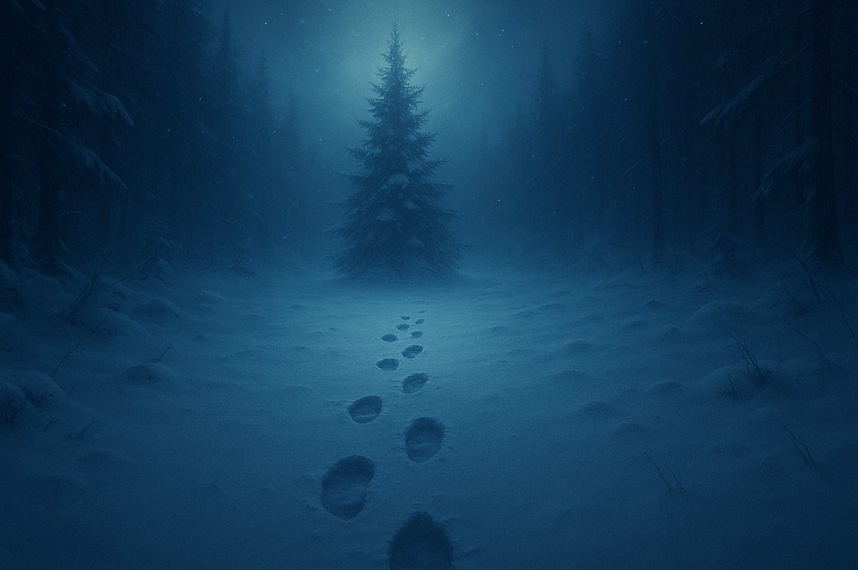 |
| One-Way Footprints |
A Hunter’s Morning Tracks—Then Nothing — Sheridan, Wyoming
Just after sunrise on December 27, 2024, hunter Calvin “Cal” Dorsey set out near the Bighorn foothills. Overnight snowfall had left a perfect blank canvas, the kind where every animal print stands out.
About half a mile from the trailhead, he noticed a single set of human-sized footprints heading north. The stride was average, the gait steady, with no sign of limping or slipping. Dorsey assumed another hunter had gone out before him.
“I followed them maybe another 150 yards,” he said, “and then they just stopped. Ended. Like someone walked straight into nothing.”
There were no overhanging branches where snow might fall and fill the prints. No rocks or ledges hidden beneath powder. The last two footprints were sharply defined, as if placed moments earlier.
Dorsey did what any experienced outdoorsman would: he circled the area, scanning for signs of off-trail movement. Nothing. Not even faint indentations.
“I’ve tracked elk for thirty years,” he said. “I know how snow behaves. These prints didn’t fade. They were there—then they weren’t.”
He reported the finding to a park ranger, who later confirmed the snow was untouched beyond the last two prints.
A Hiker in Colorado Sees a Trail to Nowhere — San Isabel National Forest
In December 2023, backpacker Emily Rhodes took a short hike near Buena Vista after a light midday snowfall. On her return, she spotted a line of footprints heading upslope from the main trail.
“They were small—maybe a woman’s size,” she said. “Neat steps, evenly spaced.”
The trail led through a soft layer of snow up toward a ridge. Rhodes followed from a distance for safety. But near the top, the prints abruptly stopped in an open clearing.
“No rocks, no patch of grass, no exposed dirt,” she said. “Just smooth snow all around. It didn’t look like they doubled back because I would’ve seen the return trail.”
Rhodes stayed longer than she intended, circling the clearing and checking elevation shifts. But the prints formed a perfect one-way path: a start, a steady climb, then a clean end.
“I’m not saying it was anything supernatural,” she added. “But I’ve never seen a trail without a return. People don’t just evaporate.”
A Mountain Resident’s Driveway Mystery — Whiteface, New York
On December 30, after a cold, windless night, Lorette Hayes stepped outside her cabin and saw something strange in her driveway: a neatly spaced line of footprints leading toward her house from the woods.
No outbound prints. No sign of anyone leaving.
“They stopped six feet from my porch steps,” she said. “Right where my motion light would’ve kicked on.”
Hayes checked her security camera but found nothing. The recording showed a blank white driveway, no visitors, no animals. The camera had missed the footprints entirely—likely because snow was falling lightly at the time.
The prints were narrower than a man’s, but longer than a child’s. They remained intact for hours.
What unsettled Hayes wasn’t the intrusion. It was the unfinished story: whoever—or whatever—made them didn’t come to the door and didn’t turn around.
“I kept waiting for the wind to fill them in,” she said. “But the edges stayed sharp until the afternoon sun hit.”
What Could Cause One-Way Footprints? Experts Weigh In
Scientists and winter tracking specialists offer several explanations, though none fit all accounts perfectly.
1. Wind Erasure
Strong gusts can remove prints on the return path while leaving others intact.
But many reports occur on calm mornings with light powder that shows even the smallest disturbance.
2. Snow Bridging
Uneven layers can form a crust firm enough to hide footprints or cause them to be extremely shallow.
But this would affect the entire area, not just part of the trail.
3. Melting and Refreezing
Sun patches or heat from trees and rocks can distort prints.
But that doesn’t explain prints ending abruptly in open, uniformly lit areas.
4. Tracks Made at Different Times
Some prints may predate snowfall and others may be partially covered.
But witnesses report single, uninterrupted trails made in snow that fell only hours earlier.
5. Wildlife Interference
Animals stepping over or through the return path might hide certain prints.
But most witnesses—especially hunters—would notice those disturbances instantly.
In short, natural explanations can account for parts of the phenomenon, but not the consistent, clean “vanishing point” seen in multiple regions.
Why These Stories Persist
People who spend time in snow—hunters, hikers, mountain residents—tend to be practical. They don’t jump to unusual conclusions. That’s why these reports catch attention: they come from people skilled at reading winter landscapes.
Another pattern stands out: most sightings occur between December 25 and January 2, a period of calm weather, minimal traffic, and plenty of pristine snow. During those days, the world slows down just enough for people to notice the details.
Some see the one-way tracks as a quirk of winter. Others view them as something older—echoes of regional folklore about Christmas wanderers or lost travelers whose spirits “walk only one direction.”
Most witnesses, though, land somewhere in between: they don’t believe in the supernatural, but they also can’t ignore what they saw.
“I’m not trying to make it dramatic,” Dorsey said. “I just know the tracks didn’t come back.”
A Winter Mystery Still Unresolved
As more hikers and hunters carry cameras, clearer evidence may emerge in the coming years. For now, the vanishing footprints remain one of winter’s quieter mysteries—visible only for a few hours, then lost to the sun and wind.
But once you’ve heard the stories, it’s hard not to look down when walking a snowy trail in late December. Hard not to wonder whether a line of footsteps tells the whole story, or only half.
Sometimes the strangest thing about winter isn’t what appears in the snow—
but what doesn’t.