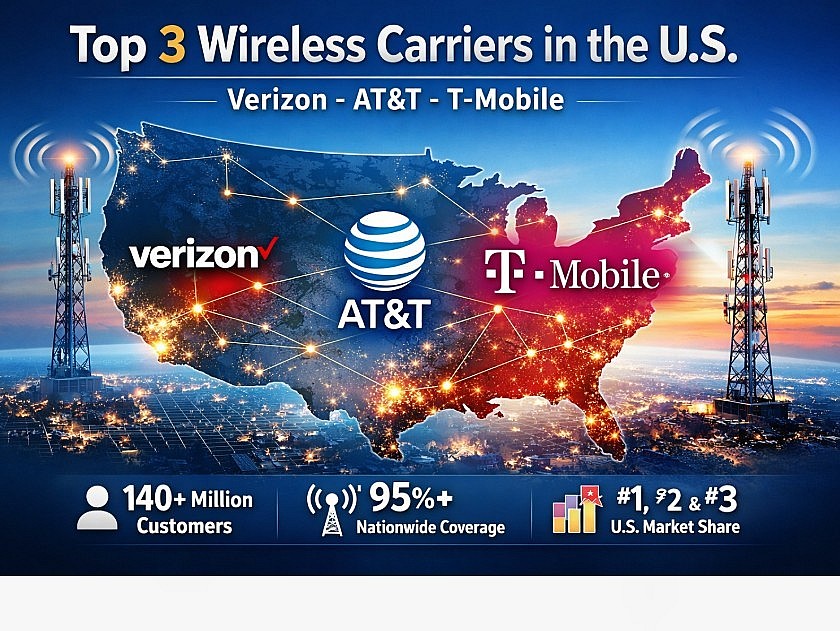
Top 3 Biggest Wireless Carriers in the U.S. Today - Who Really Runs America’s Mobile Networks?

 Top 5 Largest And Majestic Offshore Wind Farms in the US Top 5 Largest And Majestic Offshore Wind Farms in the US |
 Top 15+ Biggest and Most Stunning Solar Farms in the US Top 15+ Biggest and Most Stunning Solar Farms in the US |
 Who Is the Biggest EV Maker in the World? BYD Overtakes Tesla Who Is the Biggest EV Maker in the World? BYD Overtakes Tesla |
 |
| Top 3 Biggest Wireless Carriers in the U.S. |
America’s Wireless Network, Explained
Wireless service in the United States runs on a cellular network model, where the country is divided into thousands of geographic “cells,” each served by a cell tower. Your phone connects to the nearest tower, which then routes calls, texts, and data through the carrier’s core network — a centralized system that handles authentication, routing, billing, and emergency services.
This design enables nationwide coverage but also introduces risk: when core systems fail, outages can cascade across regions or even nationwide, as seen during major Verizon, AT&T, and cloud-related outages in recent years.
Despite dozens of wireless brands on store shelves, only three companies operate true nationwide wireless networks in the U.S.
The Big Three: America’s Nationwide Wireless Carriers
Verizon
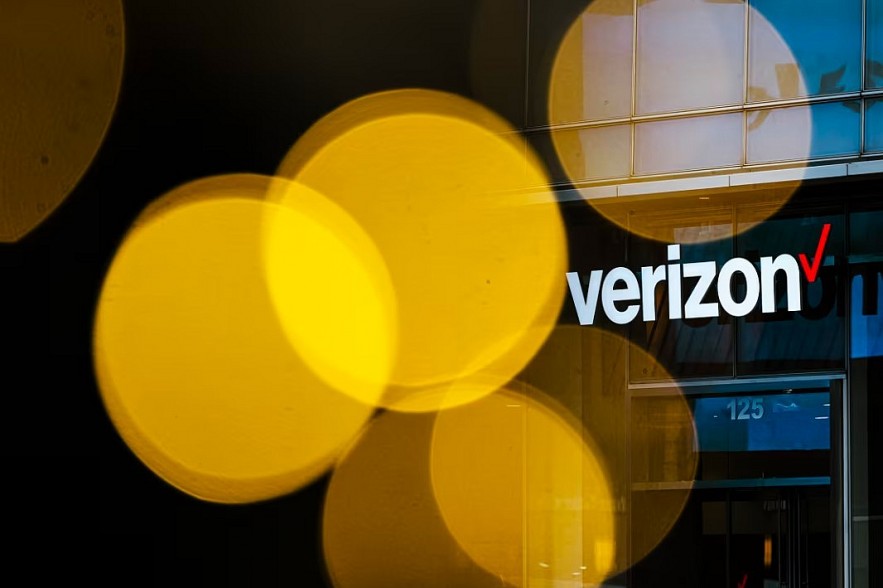 |
| Widespread Verizon outage prompts emergency alerts in Washington, New York City |
Verizon is the largest wireless carrier in the U.S. by retail connections, long known for emphasizing network reliability and coverage.
-
Founded: Corporate roots trace back to Bell Atlantic (1983)
-
Headquarters: New York City (major operations in New Jersey)
-
Wireless scale: ~146 million retail wireless connections
-
Strengths: Broad coverage, strong enterprise and government presence
-
Weakness exposed: Nationwide outages highlight centralized network risks
Verizon’s network is widely considered one of the most extensive in suburban and rural America, but recent disruptions have challenged its long-standing reliability reputation.
Read more: Top 7 Best Alternatives for Calls, Texts, and 911 When Verizon Is Down
AT&T
 |
| AT&T |
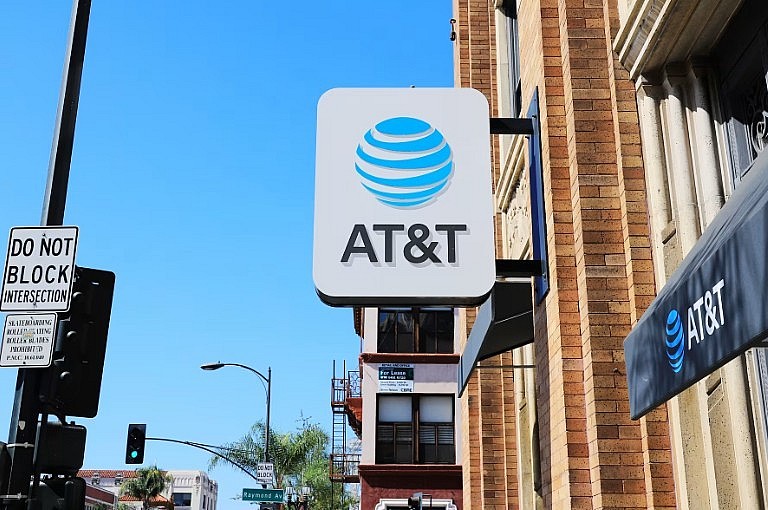
AT&T is a legacy telecom giant with deep roots in U.S. communications history and a strong push toward wireless + fiber convergence.
-
Founded: Modern AT&T Inc. in 1983 (historical roots date to the 1800s)
-
Headquarters: Dallas, Texas
-
Wireless scale: Tens of millions of subscribers; ~27% market share
-
Strengths: Bundled services, enterprise and fiber footprint
-
Strategy: Integrating mobile, broadband, and enterprise connectivity
AT&T competes less on hype and more on bundled reliability, particularly in markets where its fiber network is strongest.
T-Mobile
 |
| T-Mobile |
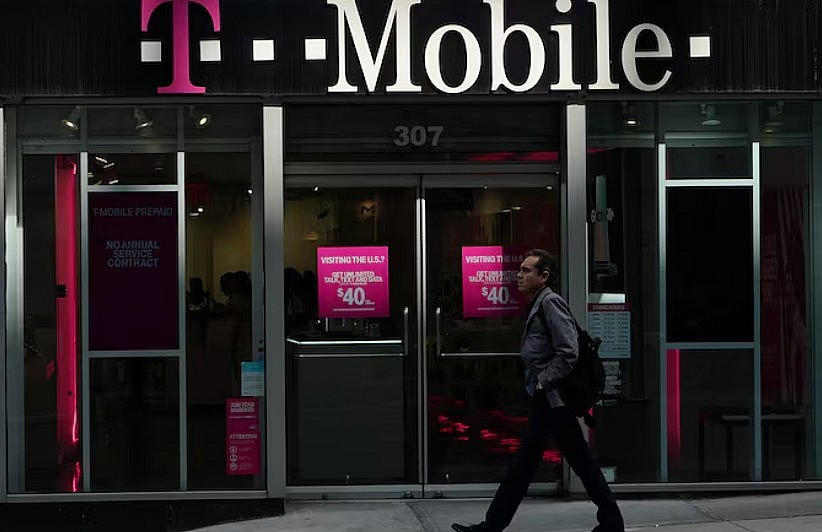
T-Mobile has evolved from challenger to heavyweight, driven by aggressive pricing and rapid mid-band 5G expansion.
-
Founded: 1994 (as VoiceStream Wireless)
-
Headquarters: Bellevue, Washington
-
Wireless scale: ~140 million subscribers
-
Market share: ~35%, currently the largest by some estimates
-
Strengths: Urban performance, fast 5G rollout, consumer pricing
Since acquiring Sprint in 2020, T-Mobile has emerged as a dominant force, particularly in metropolitan areas.
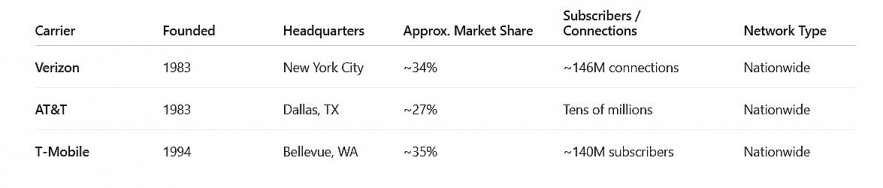
U.S. Wireless Carriers Comparison Table
(Market share figures based on industry estimates; subscriber counts rounded.)
 |
| U.S. Wireless Carriers Comparison Table |
So Why Are There So Many Wireless Brands?
Because the U.S. wireless market also includes:
MVNOs (Mobile Virtual Network Operators)
MVNOs do not own wireless networks. Instead, they lease capacity from the Big Three.
Examples include:
-
Visible (runs on Verizon)
-
Mint Mobile
-
Cricket Wireless
These brands often offer lower prices, but during major outages, they are affected when their host network fails.
Regional Wireless Carriers
Some companies operate regional networks, not nationwide ones, and rely on roaming agreements elsewhere.
-
U.S. Cellular – strongest in the Midwest
-
Alaska and rural carriers with limited geographic reach
Why This Structure Matters
Despite consumer choice, the U.S. effectively relies on three core wireless networks. That concentration means:
-
Nationwide outages affect millions simultaneously
-
MVNOs provide pricing competition but not infrastructure redundancy
-
Emergency services, roaming, and alerts depend heavily on the Big Three
This is why regulators like the Federal Communications Commission closely monitor large outages and network reliability.
The Bottom Line
The U.S. wireless market looks crowded, but its foundation is narrow. Verizon, AT&T, and T-Mobile power nearly all mobile connectivity in America — directly or indirectly.
As Americans grow more dependent on mobile networks for work, safety, and daily life, the reliability of these three carriers isn’t just a business issue — it’s a public one.