Top 5 Free and Legal Websites Americans Use to Read Books Online

 |
| What to Expect When Reading Books Online for Free |
Reading books online for free is not a shortcut or a legal gray area in the United States. Thanks to public-domain laws, nonprofit libraries, and public library systems, millions of Americans legally read books online every year without paying subscription fees.
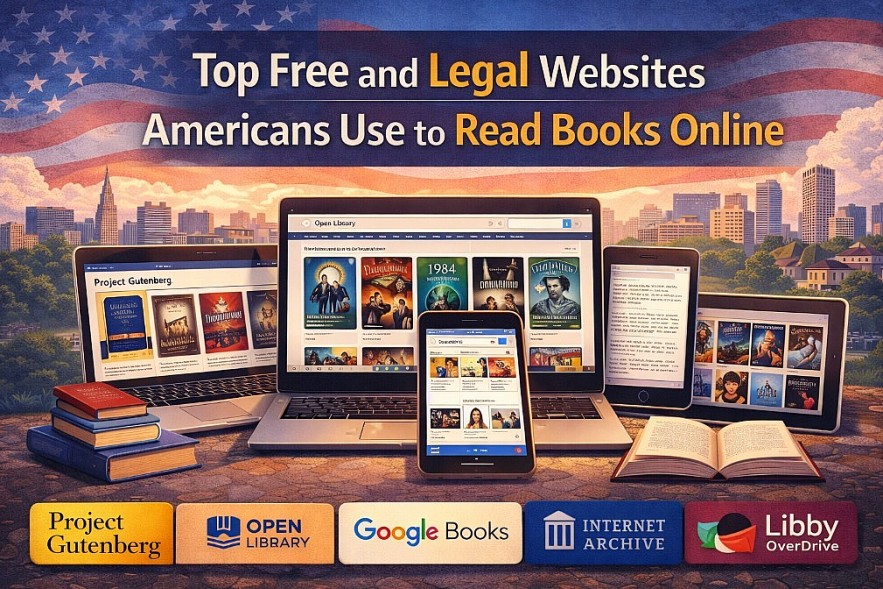
This in-depth guide highlights trusted, free, and fully legal websites Americans actually use in 2026 to read books online. These platforms are safe, reliable, and built for long-term access.
Why Free Online Reading Is Legal in the US
Free book access exists because of:
-
Public-domain laws (copyright expiration)
-
Public libraries funded by taxpayers
-
Nonprofit digital preservation projects
If a website clearly states its licensing or library partnerships, it is usually safe and legal to use.
Read more:
- Top 5 Free Ebook and Audiobook Websites for US Readers (2026 Guide)
- 25 Best Free Sites to Read Books Online Without Downloading
How These Websites Were Selected
Each platform below meets strict criteria:
-
Legal operation in the United States
-
Free access to full books (not pirated copies)
-
Clear copyright or library-based licensing
-
Stable platforms used by Americans long term
-
Works on desktop, tablet, and mobile devices
1. Project Gutenberg
Best overall website to read books online for free
Project Gutenberg is the most trusted source for free online reading in the US. It offers over 70,000 public-domain books, including classics, philosophy, history, and literature.
-
Website: https://www.gutenberg.org
-
Account required: No
-
Reading formats: Online reader, EPUB, Kindle
-
Best for: Classic literature and academic reading
2. Open Library
Best for borrowing modern books online
Open Library works like a traditional library. Users can borrow digital books for limited periods, including many 20th- and 21st-century titles.
-
Website: https://openlibrary.org
-
Account required: Yes (free)
-
Reading formats: Online reader
-
Best for: Fiction and nonfiction beyond classics
3. Google Books
Best for free previews and full public-domain books
Google Books offers full access to public-domain titles and limited previews of copyrighted books. It’s commonly used by students and researchers.
-
Website: https://books.google.com
-
Account required: No
-
Reading formats: Browser-based
-
Best for: Research, reference, and previews
4. Internet Archive
Best for academic and historical books
Internet Archive provides free online access to millions of digitized books, including textbooks, historical documents, and niche publications.
-
Website: https://archive.org/details/texts
-
Account required: No (account needed to borrow)
-
Reading formats: Online reader
-
Best for: Research, history, rare books
5. Libby
Best for public library users reading online
Libby connects readers to their local US public library. While known for apps, many users also read books directly through the web interface.
-
Website: https://www.libbyapp.com
-
Account required: Yes (library card)
-
Reading formats: Web reader, app
-
Best for: Bestsellers and modern titles
Comparison Table
| Website | Account Needed | Book Type | Best Use Case |
|---|---|---|---|
| Project Gutenberg | No | Public domain | Classic reading |
| Open Library | Yes | Borrowed titles | Modern books |
| Google Books | No | Mixed | Research |
| Internet Archive | No/Yes | Academic & rare | Study |
| Libby | Yes | Library ebooks | Bestsellers |
What to Expect When Reading Books Online for FreeFree platforms typically: • Focus on public-domain or library-licensed books • Limit borrowing time for copyrighted titles • Offer browser-based reading without downloads • This model protects authors while expanding access for readers. |
Final Recommendation
If you want instant access without accounts, start with Project Gutenberg. For newer books, combine Open Library and Libby. Researchers benefit most from Internet Archive and Google Books.
Using two or three platforms together covers nearly every reading need without cost.