U.S. Presidential Veto Power: Types, History, and How It Works

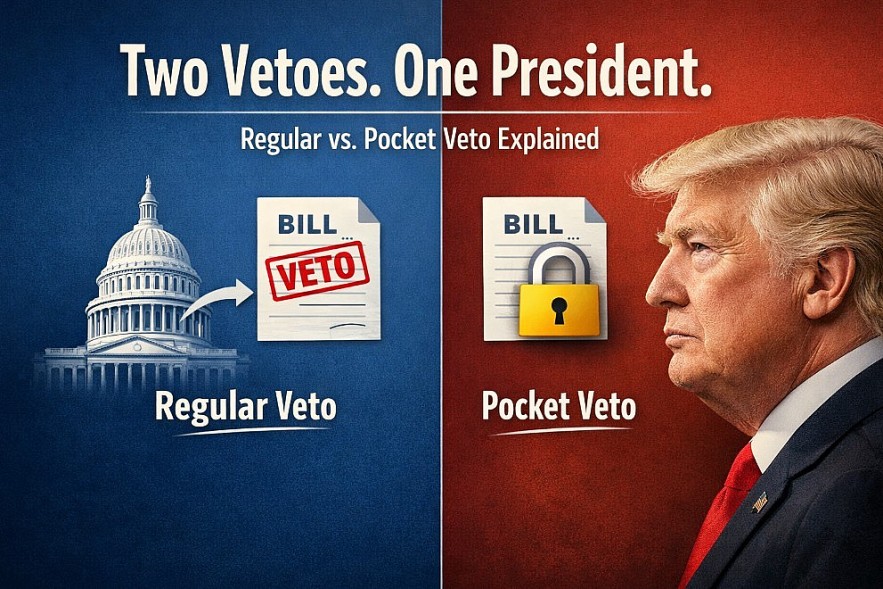 |
| Two Vetoes. One President |
President Donald Trump made headlines this week by using his veto power for the first time since returning to office. He rejected two bipartisan bills passed by Congress—one designed to ease construction of a water pipeline in Colorado, and another intended to grant a Native American tribe greater control over a portion of the Florida Everglades.
The decision has renewed public interest in a fundamental question of American constitutional law: how many types of veto power does the U.S. president have, and how do they work in practice?
The short answer is that the Constitution recognizes two forms of presidential veto, while a third, often-discussed option does not currently exist. The longer answer reveals why veto power remains one of the most important tools a president has in shaping national policy.
Read more:
- How Many Presidents Are In The United States? Full List and Interesting Facts
- How Many US Presidents Have Been Assassinated?
- 5 Youngest And Oldest U.S. Presidents in
- The Hidden Power of the Donald Trump Signature: Brand, Weapon, or Warning Sign?
Constitutional Basis of Presidential Veto Power
The president’s veto authority comes directly from United States Constitution, specifically Article I, Section 7. The framers designed the veto as part of the system of checks and balances, ensuring that Congress could not enact laws without executive review, while also preventing the president from acting unilaterally.
According to constitutional text and long-standing congressional interpretation, the president has two constitutionally valid veto options:
-
The regular veto
-
The pocket veto
Each operates differently and carries distinct political and legal consequences.
1. Regular Veto (Return Veto)
The regular veto is the most familiar and frequently used form of presidential veto power.
How It Works
After Congress passes a bill, it is sent to the president, who has 10 days (excluding Sundays) to act. During that time, the president may:
-
Sign the bill into law, or
-
Reject it and return it to Congress with a written veto message explaining the objections
Once vetoed, the bill is not dead automatically. Congress can still override the president’s decision.
Congressional Override
To override a regular veto, Congress must pass the bill again with a two-thirds majority in both the House and the Senate. This is a high bar, which is why most presidential vetoes are sustained.
Political Significance
Regular vetoes are often used to:
-
Block legislation that conflicts with presidential policy goals
-
Force renegotiation of controversial provisions
-
Signal priorities to Congress and the public
President Trump’s recent veto of the Colorado pipeline and Everglades-related bills is a textbook example of a regular veto. Congress now faces a choice: accept the veto or attempt an override.
2. Pocket Veto
The pocket veto is more subtle and procedurally complex, but also more powerful in certain situations.
How It Works
A pocket veto occurs when:
-
The president does not sign a bill within the 10-day review period, and
-
Congress adjourns before that period expires
In this case, the bill fails automatically without being returned to Congress.
Key Difference
Unlike a regular veto, a pocket veto cannot be overridden. Once Congress has adjourned, there is no opportunity to vote again on the bill.
When It Is Used
Pocket vetoes are typically used:
-
At the end of a congressional session
-
When the president wants to quietly block legislation
-
When timing prevents a formal veto message
Because of these constraints, pocket vetoes are less common, but they remain constitutionally significant.
3. Line-Item Veto: Why It Does Not Exist Today
Many Americans assume that the president can veto parts of a bill while approving the rest. In reality, this power does not exist at the federal level.
What Is a Line-Item Veto?
A line-item veto would allow a president to strike specific provisions—often spending items—while signing the rest of a bill into law. This authority is common among state governors.
Why the President Cannot Use It
Congress briefly granted line-item veto authority to the president in the 1990s. However, the Supreme Court later ruled that law unconstitutional, holding that it violated the separation of powers outlined in the Constitution.
As a result, modern U.S. presidents must accept or reject legislation in its entirety.
Why Presidential Veto Power Matters Today
Presidential veto power is more than a procedural formality. It is a central mechanism for shaping legislation, managing conflicts between branches of government, and defining executive authority.
In periods of divided government, vetoes often become tools for negotiation rather than permanent roadblocks. Even when Congress lacks the votes to override, a veto can reshape future bills, delay implementation, or mobilize public opinion.
President Trump’s first veto since returning to the White House suggests that veto power will play a major role in upcoming debates over infrastructure, environmental policy, tribal governance, and federal land use.
Historical Table: Presidential Vetoes by Congress and President
Source: U.S. House of Representatives historical records
| Congresses | President | Regular Vetoes | Pocket Vetoes | Total Vetoes | Vetoes Overridden |
|---|---|---|---|---|---|
| 1st–4th | George Washington | 2 | 0 | 2 | 0 |
| 5th–6th | John Adams | 0 | 0 | 0 | 0 |
| 7th–10th | Thomas Jefferson | 0 | 0 | 0 | 0 |
| 11th–14th | James Madison | 5 | 2 | 7 | 0 |
| 15th–18th | James Monroe | 1 | 0 | 1 | 0 |
| 19th–20th | John Quincy Adams | 0 | 0 | 0 | 0 |
| 21st–24th | Andrew Jackson | 5 | 7 | 12 | 0 |
| 25th–26th | Martin Van Buren | 0 | 1 | 1 | 0 |
| 27th | William Henry Harrison | 0 | 0 | 0 | 0 |
| 27th–28th | John Tyler | 6 | 4 | 10 | 1 |
| 29th–30th | James K. Polk | 2 | 1 | 3 | 0 |
| 31st | Zachary Taylor | 0 | 0 | 0 | 0 |
| 31st–32nd | Millard Fillmore | 0 | 0 | 0 | 0 |
| 33rd–34th | Franklin Pierce | 9 | 0 | 9 | 5 |
| 35th–36th | James Buchanan | 4 | 3 | 7 | 0 |
| 37th–39th | Abraham Lincoln | 2 | 5 | 7 | 0 |
| 39th–40th | Andrew Johnson | 21 | 8 | 29 | 15 |
| 41st–44th | Ulysses S. Grant | 45 | 48 | 93 | 4 |
| 45th–46th | Rutherford B. Hayes | 12 | 1 | 13 | 1 |
| 47th | James A. Garfield | 0 | 0 | 0 | 0 |
| 47th–48th | Chester A. Arthur | 4 | 8 | 12 | 1 |
| 49th–50th | Grover Cleveland | 304 | 110 | 414 | 2 |
| 51st–52nd | Benjamin Harrison | 19 | 25 | 44 | 1 |
| 53rd–54th | Grover Cleveland | 42 | 128 | 170 | 5 |
| 55th–57th | William McKinley | 6 | 36 | 42 | 0 |
| 57th–60th | Theodore Roosevelt | 42 | 40 | 82 | 1 |
| 61st–62nd | William H. Taft | 30 | 9 | 39 | 1 |
| 63rd–66th | Woodrow Wilson | 33 | 11 | 44 | 6 |
| 67th | Warren G. Harding | 5 | 1 | 6 | 0 |
| 68th–70th | Calvin Coolidge | 20 | 30 | 50 | 4 |
| 71st–72nd | Herbert C. Hoover | 21 | 16 | 37 | 3 |
| 73rd–79th | Franklin D. Roosevelt | 372 | 263 | 635 | 9 |
| 79th–82nd | Harry S. Truman | 180 | 70 | 250 | 12 |
| 83rd–86th | Dwight D. Eisenhower | 73 | 108 | 181 | 2 |
| 87th–88th | John F. Kennedy | 12 | 9 | 21 | 0 |
| 88th–90th | Lyndon B. Johnson | 16 | 14 | 30 | 0 |
| 91st–93rd | Richard M. Nixon | 26 | 17 | 43 | 7 |
| 93rd–94th | Gerald R. Ford | 48 | 18 | 66 | 12 |
| 95th–96th | Jimmy Carter | 13 | 18 | 31 | 2 |
| 97th–100th | Ronald Reagan | 39 | 39 | 78 | 9 |
| 101st–102nd | George H. W. Bush | 29 | 15 | 44 | 1 |
| 103rd–106th | Bill Clinton | 36 | 1 | 37 | 2 |
| 107th–110th | George W. Bush | 12 | 0 | 12 | 4 |
| 111th–114th | Barack Obama | 12 | 0 | 12 | 1 |
| 115th–116th | Donald Trump | 10 | 0 | 10 | 1 |
| 117th–118th | Joe Biden | 13 | 0 | 13 | 0 |
| 119th | Donald Trump | — | — | — | — |
| Total | 1,526 | 1,066 | 2,592 | 112 |
FAQs About U.S. Presidential Veto Power
How many types of veto power does the U.S. president have?
Under the Constitution, the U.S. president has two types of veto power: the regular veto and the pocket veto. Both are explicitly recognized in Article I, Section 7 of the Constitution.
What is the difference between a regular veto and a pocket veto?
A regular veto occurs when the president formally rejects a bill and returns it to Congress with objections. Congress may override it with a two-thirds vote in both chambers.
A pocket veto occurs when the president takes no action on a bill and Congress adjourns before the 10-day review period expires. In that case, the bill fails automatically and cannot be overridden.
Can Congress override a presidential veto?
Yes, but only for a regular veto. Congress must pass the bill again with a two-thirds majority in both the House and the Senate. Pocket vetoes cannot be overridden.
Does the U.S. president have line-item veto power?
No. Although many state governors have this authority, the U.S. president does not. Congress briefly granted line-item veto power in the 1990s, but the Supreme Court ruled it unconstitutional.
Which U.S. president used veto power the most?
Franklin D. Roosevelt used veto power more than any other president, with 635 total vetoes during his time in office, reflecting both the length of his presidency and the scale of federal legislation during the New Deal era.
Why do presidents use veto power?
Presidents use vetoes to block legislation they believe is unconstitutional, fiscally irresponsible, or inconsistent with their policy priorities. Vetoes are also used as negotiation tools to influence future legislation.