When Fashion Becomes Politics: The Debate Over Zohran Mamdani’s Wife and a White House Critic

 |
| Designer Boots, Political Optics, and a National Debate: The Controversy Over NYC’s First Lady’s Footwear |
What began as a fleeting visual detail at a New York City swearing-in ceremony has evolved into a revealing case study of how appearance, ideology, and political power collide in modern America.
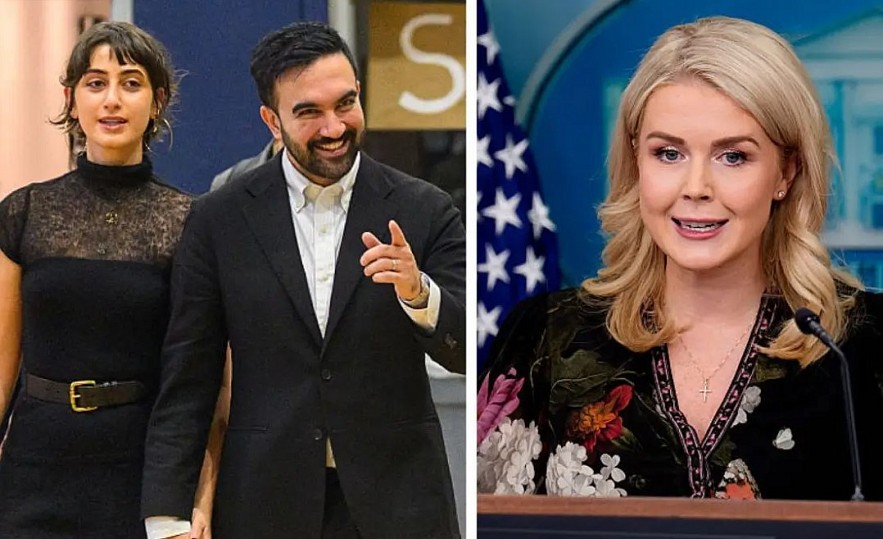
At the center of the debate are Zohran Mamdani, his wife Rama Duwaji, and Karoline Leavitt, whose sharp reaction transformed a local moment into a national argument.
Read more: The Truth Behind Claims About $630 Boots Worn by Zohran Mamdani’s Wife
A ceremony, a photograph, and an unexpected trigger
Mamdani’s inauguration was meant to mark a political milestone: a young, progressive leader taking office in America’s largest city with a platform centered on affordability, housing, and working-class relief. Standing beside him, Duwaji drew attention not for a speech or a statement, but for a pair of sleek leather boots later identified as a designer brand.
In most political eras, such a detail would have passed unnoticed. In today’s hyper-visual, hyper-polarized environment, it became symbolic. Online critics quickly framed the boots as evidence of hypocrisy—arguing that luxury fashion clashed with Mamdani’s economic messaging.
Why Karoline Leavitt’s reaction mattered
The debate intensified when Leavitt publicly weighed in. As the White House press secretary, her role typically centers on national policy, messaging discipline, and institutional authority. By choosing to comment on the attire of a city mayor’s spouse, she elevated the story far beyond social media chatter.
Supporters of Leavitt argue her criticism was ideological, not personal: a challenge to what they see as inconsistencies between progressive rhetoric and personal lifestyle. From this perspective, symbolism matters, and public figures—especially those advocating redistribution—should expect scrutiny.
Yet critics saw something else entirely: a double standard. Leavitt herself is widely known for her polished, high-end professional wardrobe. To many observers, her critique appeared less like a principled stand and more like selective outrage—fashion becoming a political weapon rather than a genuine policy argument.
Read more: Zohran Mamdani Net Worth Revealed: Salary vs. Savings and Assets in Uganda
Rama Duwaji: visible, but not elected
Notably, Duwaji holds no public office. She has not advanced legislation, shaped budgets, or delivered campaign promises. Still, she found herself pulled into a political narrative largely because of proximity.
People familiar with the Mamdani family say the boots were borrowed, not purchased, and part of a broader approach to styling that mixes sustainability, reuse, and artistic expression. Duwaji herself has not publicly sparred with critics, choosing restraint over rebuttal.
That silence has become part of the story. For supporters, it underscores how political discourse increasingly targets optics rather than substance. For critics, it does little to quiet claims that visual symbols matter, regardless of intent.
The deeper question: what do we expect politicians to “look like”?
The episode exposes a recurring tension in American politics. Voters often demand authenticity and ideological purity, yet political life unfolds in a society where luxury, branding, and image are deeply embedded.
Should a politician’s spouse visually reflect a policy platform?
Is borrowed or gifted fashion different from personal wealth?
And why do similar fashion choices spark outrage in some cases but indifference in others?
These questions linger because the controversy is not really about boots. It is about who gets scrutinized, who gets a pass, and who defines the rules.
Read more: Who Is Rama Duwaji? Meet Zohran Mamdani’s Wife and the Syrian Artist Redefining NYC Politics
A distraction—or a mirror?
For New York City, the practical work of governing continues: housing shortages, transit funding, public safety, and economic pressure remain unresolved. The footwear debate does nothing to address those issues directly.
Yet it serves as a mirror of contemporary politics, where symbolism travels faster than policy and where even minor visual cues can be reframed as moral statements.
In that sense, the controversy may be less about what Duwaji wore—and more about how quickly American politics turns images into arguments, and arguments into identity battles.