Fighter Jet Crashes Near Trona Airport in San Bernardino: Reports Suggest It Was a USAF Thunderbird F-16

Early reports circulating online suggest the aircraft was an F16C Fighting Falcon from the U.S. Air Force Thunderbirds demonstration team, although the Air Force has not officially confirmed the jet's unit.
The crash took place in a remote stretch of desert roughly 27 miles from Naval Air Weapons Station China Lake. Because of the isolated terrain and lack of nearby structures, there are no reports of injuries on the ground.
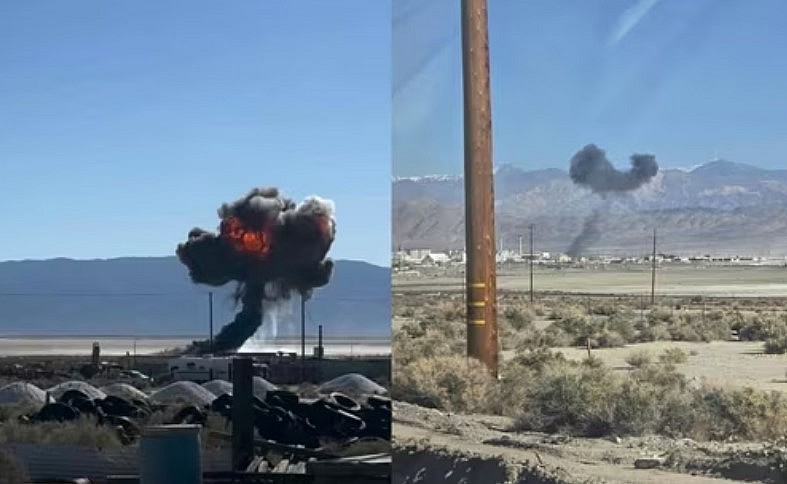 |
| A fighter jet has reportedly crashed near Trona Airport in San Bernardino County, California on Wednesday |
Timeline of the Incident
Authorities say the crash occurred at approximately 10:28 a.m. Pacific Time. Fire crews from San Bernardino County Station 57 were the first on scene after receiving a call about an aircraft emergency. Emergency teams from China Lake, including military firefighters and medical personnel, also responded quickly because of the proximity to restricted training airspace.
Shortly after the crash, videos and photos surfaced on social media showing a column of black smoke, along with footage of a parachute in the air. This fueled early speculation that the pilot had successfully ejected and that the aircraft belonged to the Thunderbirds, who were reportedly training out of Nellis Air Force Base that morning.
Pilot Ejected and Survived
Officials confirmed that the pilot ejected before impact and was taken to a hospital in Ridgecrest. Initial assessments list the pilot as suffering minor to moderate injuries. He remains in stable condition and is expected to recover.
The Air Force has acknowledged that a single engine fighter jet went down during a routine training operation but has declined to confirm whether it was part of the Thunderbird squadron. More information is expected as the investigation progresses.
Why Trona and China Lake Are Key to the Story
The desert region around Trona Airport is a major hub for U.S. military aviation activity. China Lake supports weapons development, air to ground test ranges, and controlled airspace for advanced training flights. Many aircraft from Nellis, Edwards, and other bases routinely transit through the area.
The remote geography means crashes, while rare, pose less danger to populated communities. This also helps explain the absence of civilian casualties and the quick response from specialized rescue teams.
What Is Confirmed So Far
Authorities have verified several core facts:
-
A military fighter jet crashed near Trona Airport on Wednesday morning.
-
The pilot ejected and survived.
-
Emergency teams from both civilian and military agencies secured the crash site.
-
No residents or structures were harmed.
These points form the backbone of the official narrative at this stage. Everything beyond this remains part of ongoing analysis.
Unconfirmed Reports and Ongoing Questions
Social media posts and eyewitness statements have strongly suggested that the aircraft was Thunderbird 5, one of the solo demonstration jets in the Air Force's elite aerial team. A photographer claimed to have documented the jet’s last takeoff from Nellis Air Force Base before only five of the six Thunderbirds returned.
Until the Air Force releases the tail number and unit details, these claims remain unverified. The Air Force has historically exercised extreme caution when releasing details about accidents involving demonstration aircraft, both for investigative integrity and because of public interest.
Another major unknown is the cause of the crash. Investigators will look at several factors:
-
Possible mechanical failure
-
Flight control issues
-
Environmental conditions
-
Human factors
-
Bird strike or foreign object damage
Military accident investigations typically take weeks or months, with a preliminary statement expected sooner.
Why a Thunderbird Crash Would Be a Significant Event
If confirmed, this would mark a rare incident involving one of the most recognizable aerial demonstration teams in the world. Thunderbird aircraft are maintained under strict standards and undergo constant inspections because of the high risk nature of precision aerobatics.
Any accident involving a Thunderbird raises immediate questions about maintenance cycles, pilot procedure, and operational risk management. It also tends to trigger temporary grounding of demonstration flights until safety reviews are complete.
Historically, Thunderbird crashes are uncommon but not unprecedented. When they do occur, they lead to service wide evaluations and updates to training and safety rules.
Local and Military Response
The joint response from San Bernardino County Fire, China Lake emergency units, and law enforcement suggests that standard aviation mishap protocols were followed efficiently.
This includes:
-
Securing the crash site
-
Preparing for potential fuel or ordnance hazards
-
Coordinating airspace restrictions
-
Providing medical evacuation for the pilot
Because the crash occurred in a controlled military zone, federal investigators will now take the lead. Civilian agencies will assist where needed but will defer to Air Force safety boards.
What Happens Next
The next 72 hours are expected to bring several key updates:
-
Identification of the aircraft
The Air Force will likely release the aircraft type, tail number, and unit once internal notifications are complete. -
Initial accident assessment
A preliminary report will outline what investigators observed at the crash site. -
Thunderbird team statement
If the aircraft is confirmed to be part of the squadron, public relations officers will issue a structured update addressing safety, pilot status, and next steps for scheduled performances. -
Airspace review
Air Force Safety Center and Federal Aviation Administration teams may conduct temporary restrictions during investigation flights.
Longer term, the final accident report could take months and will detail the exact cause and contributing factors.
FAQs
Was the crashed jet officially confirmed as a Thunderbird F16?
No. While viral posts and eyewitness accounts claim it was a Thunderbird jet, the Air Force has not released official confirmation.
Was anyone injured on the ground?
No injuries or property damage have been reported. The crash happened in an isolated desert area.
What is the condition of the pilot?
The pilot survived after ejecting and is listed in stable condition with minor to moderate injuries.
What happens to Thunderbird performances after an incident like this?
If a Thunderbird aircraft is involved, the team may pause flight operations pending a safety evaluation.
How long will the investigation take?
Preliminary findings often come within days, but full reports can take several months.