Snow Day or Remote Learning? What Parents Should Really Expect During Major Winter Storms

 |
| Virtual Learning Snow Days Are Bad For Everyone's Mental Health |
When a major winter storm barrels toward the U.S., parents aren’t just checking snow totals anymore. They’re checking school emails, text alerts, and district websites, asking a very different question than they did five years ago:
Will this be a real snow day — or just school on a screen?
Across much of the country, the traditional snow day is quietly disappearing. In its place: remote learning days that keep classes running even when roads are dangerous and weather conditions are severe. The shift has sparked confusion, frustration, and growing debate among families.
Here’s what’s actually driving school decisions during winter storms — and what parents should realistically expect next.
Read more:
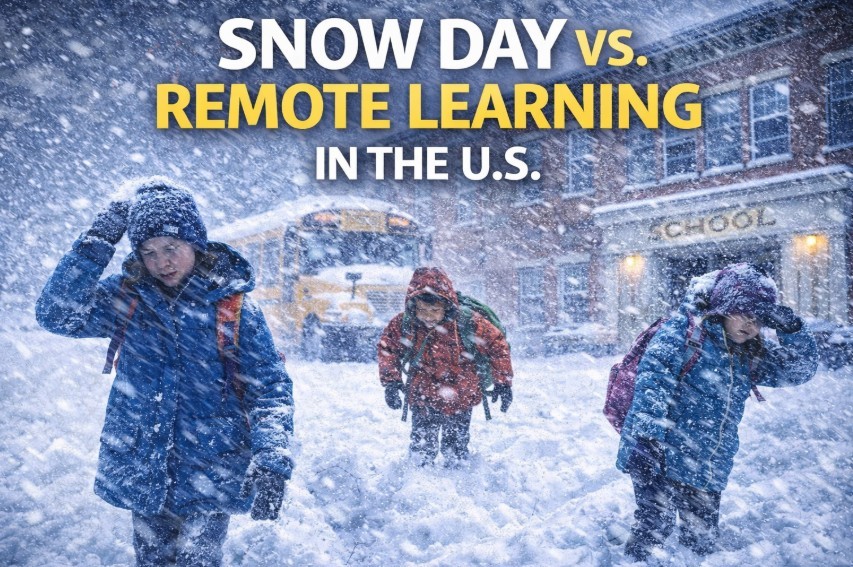
- Snow Days vs. Remote Learning in the U.S.: How the 10 Largest States Handle School Closures
- Snow Days vs. Remote Learning: How School Closures Work Across Different U.S. States
How Snow Days Changed After COVID
Before the pandemic, most districts built several snow days into the academic calendar. If weather forced closures beyond that limit, schools often added days to the end of the year.
COVID changed that math.
Once districts proved they could teach remotely, many school boards rewrote their weather policies. Today, hundreds of districts now use terms like “remote learning day” or “flexible instruction day” to avoid canceling school outright.
Administrators say the approach prevents lost instruction time. Parents say it ignores reality during winter storms.
What School Leaders Actually Consider
Contrary to popular belief, snowfall totals alone do not determine school closures.
According to guidance commonly referenced by districts and emergency planners, including the National Weather Service, school officials weigh several concrete factors:
-
Road safety for buses, especially on secondary streets
-
Ice risk, which is more dangerous than snow
-
Power outages, common during ice and wind events
-
Storm timing, particularly overnight vs. early morning
-
Local capacity to clear roads before the commute
If roads are passable by morning and power is stable, many districts now default to remote learning instead of closing.
Read more: Will Schools Close? What Families in Storm-Hit States Need to Know
Why Remote Snow Days Often Fall Apart
On paper, remote learning sounds simple. In practice, winter storms expose its weaknesses.
Parents across storm-hit states report the same problems:
-
Internet outages during heavy snow or ice
-
Power failures that make online classes impossible
-
Younger students unable to log in independently
-
Parents forced to juggle work while supervising school
In ice-prone states like Georgia or Texas, where outages can last days, many districts still cancel school entirely. In the Northeast, where infrastructure is stronger, remote learning is far more common — even during heavy snow.
What to Expect by Region
Northeast & Upper Midwest:
Large districts increasingly choose remote learning or delayed starts, especially if plows can clear main roads by early morning.
Mid-Atlantic:
Decisions are more weather-sensitive. Ice or mixed precipitation often leads to virtual instruction, even with modest snow totals.
Southern States:
Full closures remain common. Ice storms, not snow, drive decisions due to outage risk and limited road treatment capacity.
When Decisions Are Usually Announced
Parents often complain that school decisions come too late. There’s a reason.
Districts typically wait for:
-
Final overnight weather data
-
Early-morning road condition reports
-
Power outage updates
That’s why announcements often arrive between 5 a.m. and 6 a.m., or late the night before if confidence is high.
How Parents Can Prepare Without Guessing
Given today’s uncertainty, families are advised to prepare for both outcomes.
That means:
-
Assuming remote learning is possible, even on heavy snow days
-
Charging devices before storms arrive
-
Planning childcare contingencies
-
Setting realistic expectations if outages disrupt classes
Preparation reduces stress when plans change at the last minute.
Is the Traditional Snow Day Really Gone?
Not entirely — but it’s no longer guaranteed.
Some districts now cap the number of remote snow days and preserve a few true days off. Others are reconsidering policies after backlash from parents and teachers who argue that snow days serve an important mental and emotional purpose.
For now, though, remote learning is the default in many parts of the country, not the exception.
Parents’ Checklist: How to Prepare for a Snow Day That May Go RemoteBefore a winter storm hits, parents are encouraged to prepare for both a school closure and a remote learning day. Before the storm Fully charge laptops, tablets, phones, and backup batteries Confirm your child’s login details and class schedule Download assignments in case internet access is disrupted During the storm Check school district emails, texts, and official websites regularly Be flexible if power or connectivity issues occur Communicate with teachers if your child cannot log in For younger students Set up a quiet, safe learning space Prepare activities in case online classes are shortened or canceled Backup plan Have childcare and work-from-home contingencies ready Don’t assume a traditional snow day — plan for remote learning unless told otherwise |
The Bottom Line
During major winter storms, parents should no longer assume school will simply be canceled. Instead, the more likely question is how learning will continue — and whether conditions will actually support it.
Understanding how and why districts make these decisions helps families prepare, plan ahead, and avoid last-minute chaos when the next storm hits.
FAQs: Snow Days and Remote Learning During Winter Storms
Are snow days officially eliminated?
No. Most school districts still allow true snow days, but many now limit them and use remote learning instead.
Who decides whether schools close or go remote?
Local school districts make the decision, often based on road safety, power reliability, and weather guidance from the National Weather Service.
When are decisions usually announced?
Typically late the night before or early morning, often between 5 a.m. and 6 a.m.
What if power or internet fails during remote learning?
Many districts excuse absences or adjust expectations when outages are widespread.
Will remote snow days continue long-term?
Most experts expect remote learning to remain a common option, though some districts are rethinking policies after parent feedback.