Snow Days vs. Remote Learning in the U.S.: How the 10 Largest States Handle School Closures

 US Calendar 2026: Complete List of Public Holidays and National Observances With Dates and Celebrations US Calendar 2026: Complete List of Public Holidays and National Observances With Dates and Celebrations Explore the complete 2026 U.S. calendar of public holidays and national observances. Learn exact dates, meanings, and celebration traditions across America with this detailed guide ... |
 School Holidays and Breaks in the US 2026: Key Dates, Schedules - Month by Month School Holidays and Breaks in the US 2026: Key Dates, Schedules - Month by Month A complete guide to school holidays and breaks in the US for 2026. Learn national patterns, major breaks, regional differences, and planning tips for families ... |
When bad weather hits, parents across the country ask the same question:
Is school canceled, moved online, or made up later?
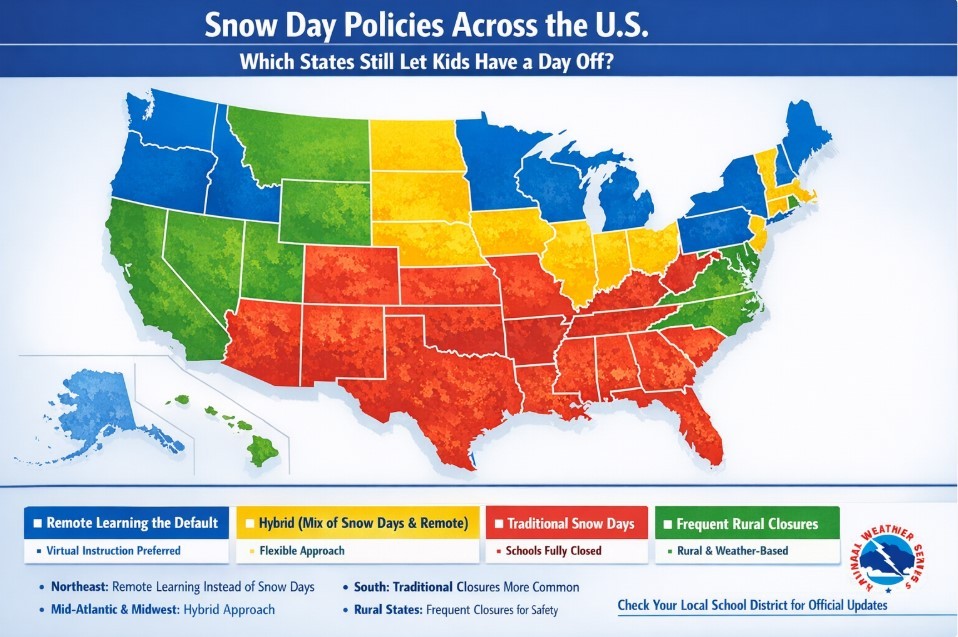
In the United States, there is no single national policy for snow days or weather-related school closures. While the U.S. Department of Education oversees broad education guidance, closure decisions are made at the state and district level.
Below is a clear, parent-friendly comparison of how the 10 most populous U.S. states handle snow days, remote learning, and makeup requirements in 2026.
Read more:
Snow Days vs. Remote Learning: How School Closures Work Across Different U.S. States
Spring Break 2026: When Do U.S. Schools Take a Break — and Why It’s Rarely the Same Week
 |
| Snow Days vs. Remote Learning in the U.S |
At-a-Glance Comparison: 10 Largest States
| State | Traditional Snow Days | Remote Learning | Key Limit to Remember |
|---|---|---|---|
| California | Rare | Common in emergencies | Continuity plans, not true “snow days” |
| Texas | Rare | Yes | Built-in minutes & waivers |
| Florida | No | Yes | Hurricane-driven closures |
| New York | Yes | Optional by district | Remote not guaranteed |
| Pennsylvania | Yes | Limited | 5 Flexible Instruction Days max |
| Illinois | Yes | Limited | Often up to 5 e-learning days |
| Ohio | Yes | Yes | Up to 3 online days |
| Georgia | Rare | Yes | District-controlled |
| North Carolina | Occasional | Yes | 5 days / 30 hours cap |
| Michigan | Yes | Yes | Up to 6 forgiven days |
State-by-State Breakdown (What Parents Actually Need to Know)
California
Common closures: Wildfires, smoke, extreme heat, power shutoffs
California rarely experiences true snow days. Instead, districts focus on instructional continuity, often using independent study or emergency learning plans during closures.
Parent takeaway: A closure usually means some form of learning, not a free day.
Official references:
Texas
Common closures: Severe storms, flooding, occasional winter freezes
Texas districts rely heavily on banked instructional minutes and weather makeup days. If closures exceed built-in flexibility, districts may apply for state waivers.
Parent takeaway: Whether school is “made up” depends on how many minutes the district has already banked.
Official references:
Read more: 2026 Texas Public School Calendar: Key Dates, Breaks, and What Families Should Know
Florida
Common closures: Hurricanes, tropical storms, flooding
Florida does not deal with snow days. Instead, closures are driven by hurricane season, with districts adjusting calendars locally.
Parent takeaway: Expect sudden changes; hurricane impacts often reshape the school calendar.
Official references:
New York
Common closures: Snow, ice, severe winter weather
Snow days are still common in New York. Districts may offer remote learning, but they are not required to, and practices vary widely.
Parent takeaway: Do not assume a snow day equals remote learning.
Official references:
Read more: 2026 New York Public School Calendar: Key Dates, Holidays & Breaks for NYC Students and Families
Pennsylvania
Common closures: Snow, ice, flooding
Pennsylvania allows districts to use up to five Flexible Instructional Days (FIDs) for remote learning during emergencies. After that, makeup days are required.
Parent takeaway: Remember the rule: FID = 5 maximum.
Official references:
Illinois
Common closures: Snow, extreme cold
Illinois districts with approved e-learning plans typically must use e-learning days (often up to five) before requesting forgiveness or extending the calendar.
Parent takeaway: Ask whether your district has an approved e-learning plan.
Official references:
Ohio
Common closures: Snow, ice, severe cold
Ohio permits districts to use online day plans for up to three days as a substitute for traditional snow days.
Parent takeaway: After three online days, makeup time is likely.
Official references:
Georgia
Common closures: Ice storms, severe weather, occasional hurricane impacts
Georgia leaves most decisions to local districts, many of which use “Digital Learning Days.”
Parent takeaway: Neighboring districts may follow completely different rules.
Official references:
North Carolina
Common closures: Snow (inland), hurricanes (coastal)
North Carolina law allows districts to use up to five remote instruction days or 30 hours total for weather-related closures.
Parent takeaway: Remote learning is allowed—but capped.
Official references:
Michigan
Common closures: Snow, extreme cold, power outages
Michigan allows districts to count up to six “forgiven” days toward instructional requirements.
Parent takeaway: Michigan’s rule is one of the clearest: six forgiven days.
Official references:
What This Means for Families in 2026
-
Snow days still exist, but they no longer mean the same thing everywhere
-
Remote learning is state- and district-dependent
-
Many states impose strict limits on virtual days
-
Multiple closures can still extend the school year into June
The Bottom Line
There is no universal U.S. snow day policy—even among the largest states.
In 2026, school closures depend on climate, state law, district planning, and technology access.
For parents, the smartest move is simple:
Know your state’s limits and your district’s specific policy before weather hits.