Top 10 Most Common Cybersecurity Scams in 2026 and How to Recognize and Respond to Them

 |
| What scam causes the most financial loss |
Cybercrime in 2026 is no longer about poorly written emails or fake princes asking for money. It has evolved into a global, AI-assisted, multi-billion-dollar industry that targets individuals and businesses in every developed country. Attackers today use artificial intelligence, stolen data, psychological profiling, deepfake audio, deepfake video, automated bots, and sophisticated social engineering to manipulate victims.
The United States, Canada, the United Kingdom, Australia, and nations across the European Union all report year-over-year increases in cyber fraud losses. The FBI’s most recent estimates place U.S. cybercrime damages in the tens of billions annually. The U.K.’s National Crime Agency calls fraud “the most common crime in the country.” Australian authorities warn that scams are growing faster than enforcement. Europol reports a surge in cross-border digital fraud rings using AI to scale attacks.
**1. Phishing Emails
Still the World’s Most Common Cyber Attack**
Phishing remains the primary gateway for cybercriminals because it exploits people, not systems. And people remain the weakest point.
How This Scam Works
Attackers send emails pretending to be:
-
Banks
-
Cloud services such as Microsoft 365 or Google
-
Shipping companies
-
Tax authorities
-
Employers or executives
Their goal is simple:
Make you click a link or open a file that hands them access.
Real-World Cases (U.S., U.K., Canada, EU, Australia)
-
In the U.S., a large medical network suffered a breach through a single fake payroll email.
-
In the U.K., phishing emails pretending to be from HMRC became one of the most successful seasonal scams.
-
In Canada, a wave of scam emails claiming “CRA account suspended” led to thousands of identity theft cases.
-
Across Europe, phishing emails mimicking delivery notifications surged during holiday seasons.
-
In Australia, banks warn customers weekly about fake transfer alerts impersonating major institutions.
Warning Signs
-
Messages demanding immediate action
-
Slight misspellings in sender name
-
Suspicious attachments
-
“Reset password now” links you didn’t request
How to Respond
-
Do not click anything.
-
Verify with the organization through its official website.
-
Report to your email provider or security team.
How to Prevent
-
Use multi-factor authentication.
-
Never reuse passwords.
-
Educate employees and family members regularly.
**2. Smishing and Vishing
Text and Phone Scams Growing Fast**
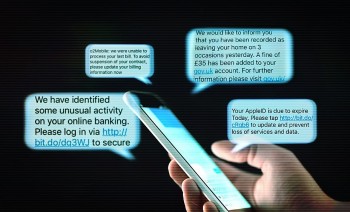
These attacks manipulate urgency. Because people check messages instantly, scammers know they can trigger fast reactions.
How These Scams Work
-
Smishing (SMS phishing): A text with a malicious link.
-
Vishing (voice phishing): A phone scam using caller ID spoofing.
Examples from Developed Countries
-
U.S.: Fake FedEx/UPS delivery texts lead victims to credential-harvesting sites.
-
Canada: Bank impersonation calls use realistic scripts generated by AI.
-
U.K.: “Royal Mail unpaid fee” texts became widespread.
-
Australia: Government reported a surge in “Hi Mum/Hi Dad” scams where criminals impersonate children needing urgent money.
-
EU: Telecom spoofing scams trick users into giving banking login codes.
Warning Signs
-
Unfamiliar numbers
-
Messages requesting verification codes
-
Threats of account closure
How to Respond
-
Do not reply.
-
Block the number.
-
Call the organization using a verified number.
Prevention
-
Enable spam call filters.
-
Never share one-time passcodes.
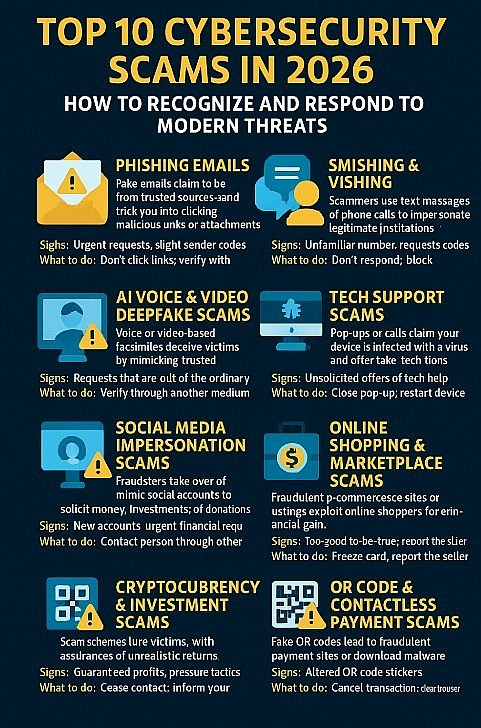 |
| Top 10 Cybersecurity Scams You Are Most Likely To Encounter |
**3. AI Voice and Video Deepfake Scams
A Rising Threat Across Corporate and Personal Communication**
Deepfake technology has transformed online scams. Attackers now clone voices from short audio clips or build fake video calls.
How This Scam Works
AI imitates:
-
CEOs and executives
-
Bank managers
-
Government officials
-
Family members
Real Cases
-
U.K.: A finance officer wired hundreds of thousands after receiving what sounded exactly like the CEO’s voice.
-
U.S.: Parents reported deepfake calls mimicking their children crying for help.
-
EU: Fraudsters impersonated executives in video calls during mergers and acquisitions.
-
Australia: Deepfake celebrity crypto endorsements tricked thousands.
Warning Signs
-
Requests made outside normal procedure
-
Poor video background or lag
-
Audio that sounds slightly processed
How to Respond
-
End the call.
-
Verify identity through another channel.
-
Follow multi-step financial approval processes.
Prevention
-
Establish code phrases for verification.
-
Train employees on deepfake risks.
**4. Tech Support Scams
Targeting Seniors, Remote Workers, and New Device Users**
Tech support scams spread aggressively in the U.S., U.K., Australia, and Canada, especially targeting older individuals.
How This Scam Works
-
You receive a popup saying “Your computer is infected.”
-
A phone number asks you to call for help.
-
The scammer asks for remote access.
-
They charge for fake repairs or steal data.
Actual Incidents
-
U.S.: Seniors lost millions to scammers impersonating Microsoft support.
-
Australia: Fake Apple security alerts asking for remote access.
-
U.K.: “BT internet security” scams demanding payments to avoid service termination.
Warning Signs
-
Unsolicited tech help
-
Scare tactics
-
Requests for remote access
How to Respond
-
Close the browser.
-
Restart the computer.
-
Never call the number in the popup.
Prevention
-
Educate older relatives.
-
Use ad blockers.
-
Avoid installing unknown apps.
 Best Ways To Stop Phone Spam, Scams and Robocalls Best Ways To Stop Phone Spam, Scams and Robocalls Spam and scam calls can be annoying and sometimes even dangerous, and you want to block them forever. Then, this article is right for you. ... |
**5. Social Media Impersonation Scams
Hacked Profiles and Fake Influencers**
Criminals hijack accounts or create clones to trick victims.
How It Works
-
Fake “friend” asks for financial help
-
Influencer posts promising crypto returns
-
Scammers send malware links via DM
-
Fake charity campaigns
Examples
-
U.S.: Facebook and Instagram saw large waves of hacked accounts promoting investment scams.
-
Canada: Fraudsters impersonated banks on LinkedIn recruiting victims into fake job scams.
-
EU: WhatsApp used heavily for family impersonation messages.
-
Australia: Influencer impersonation scams skyrocketed.
Warning Signs
-
New accounts
-
Requests for urgent money
-
Requests to move chats to private platforms
How to Respond
-
Contact the real person on a separate platform.
-
Report and block.
Prevention
-
Strong passwords
-
Multi-factor authentication
-
Caution with quizzes and viral challenges
**6. Ransomware Scams
More Targeted, More Personal, More Damaging**
Ransomware no longer targets only corporations. Now individuals and small businesses are hit.
How It Works
-
Malware encrypts files.
-
Attackers demand money for decryption.
Incidents
-
U.S.: Small clinics shut down for days.
-
EU: Schools attacked during exam season.
-
U.K.: Local councils held hostage.
-
Australia and Canada: Small businesses targeted via phishing attachments.
Warning Signs
-
Files unreadable
-
System slowdown
-
Strange extensions
-
Ransom message
How to Respond
-
Disconnect from network
-
Contact cybersecurity professionals
-
Restore from offline backups
Prevention
-
Regular updates
-
Endpoint protection
-
Offline backups
 15 Pocket Tips to Avoid Tourist Scams in Europe Today 15 Pocket Tips to Avoid Tourist Scams in Europe Today Scams are everywhere, and you need to be careful whenever you want to travel anywhere. These useful and helpful tips will help you avoid tourist ... |
**7. Online Shopping and Marketplace Scams
Growing Fast with the Expansion of E-Commerce**
Online shopping fraud remains one of the most damaging scams globally.
How These Scams Work
-
Fake brand stores
-
Counterfeit goods
-
“Too good to be true” prices
-
Fake reseller accounts on marketplaces
Examples
-
U.S.: Fake appliance stores took millions during holiday sales.
-
U.K.: Fraudulent clothing websites targeted teenagers via TikTok ads.
-
EU: QR code parking scams redirected payments to criminals.
-
Australia: Fake pet adoption sites increased 2024–2025, still common in 2026.
Warning Signs
-
No customer reviews
-
Recent domain creation
-
No refund policy
How to Respond
-
Inform your bank
-
Freeze your card
-
Report the retailer
Prevention
-
Buy from known retailers
-
Avoid suspicious prices
-
Use secure payment systems
**8. Job and Recruitment Scams
Especially Common in Remote Work Environments**
Job scams skyrocketed after remote work became mainstream.
How This Scam Works
-
Fake job offers
-
Unofficial interviews via messaging apps
-
Requests for upfront fees
-
Fake checks sent for “equipment reimbursements”
Real Cases
-
Canada: Thousands targeted by fake remote job postings disguised as major employers.
-
U.K.: Scam recruiters impersonating real companies on LinkedIn.
-
U.S.: Identity theft through fake background check requests.
Warning Signs
-
High salary with minimal experience
-
Interview via chat only
-
No company domain in emails
How to Respond
-
Research the employer
-
Refuse to pay upfront fees
-
Verify job offers via official company site
**9. Cryptocurrency and Investment Scams
Still Growing Despite Warnings**
Crypto scams thrive because people fear missing out on quick profit.
How These Scams Work
-
Fake exchanges
-
Fraudulent trading bots
-
Celebrity deepfake endorsements
-
Pump-and-dump groups
-
Romance scams involving crypto transfers
Examples
-
U.S.: AI-generated influencer deepfakes promoting fake investment apps.
-
Australia: “Wallet-draining” scams via malicious links spread rapidly.
-
EU: Telegram investment groups used by criminal gangs.
-
Canada: Seniors increasingly targeted with crypto ATM instructions by scammers.
Warning Signs
-
Guaranteed high returns
-
Requests to move funds to private wallets
-
Pressure to act fast
How to Respond
-
Stop communication
-
Notify your bank
-
Never send more money to “unlock funds”
 Top 15 Common Tourist Scams In The World Today Top 15 Common Tourist Scams In The World Today Scammers are everywhere, and tourists are the easy targets to fall victims to their crime. Keep scrolling down to learn more about the most common ... |
**10. QR Code and Contactless Payment Scams
A Modern Threat in Public Spaces**
With the rise of mobile payments, scammers swap legitimate QR codes with malicious ones.
How It Works
-
QR sticker placed over real code
-
Links redirect to fraudulent payment portals
-
Malware installs silently
Global Incidents
-
EU: Parking meter scams in multiple cities
-
U.S.: Fake QR codes in restaurant menus
-
Australia: Event ticket QR scams
-
U.K.: Public transport QR fraud
Warning Signs
-
Code stickers that look tampered
-
Payment screens with incorrect domain names
How to Respond
-
Close the page
-
Clear browser data
-
Monitor bank account
Global Trends in Cybercrime (2026)
1. AI makes scams scalable
Attackers run thousands of hyper-personalized scams per day.
2. Cross-border criminal networks are growing
EU and North American agencies report increased collaboration among cyber gangs.
3. Seniors and young adults are the most targeted
Two very different vulnerabilities:
-
Seniors trust authority
-
Young adults trust digital convenience
4. Deepfake fraud is becoming mainstream
Especially in corporate finance environments.
5. Identity theft is at an all-time high
Fueled by massive data leaks.
How to Protect Yourself: A Complete Action Checklist
For Individuals
-
Use multi-factor authentication everywhere
-
Keep software updated
-
Back up devices weekly
-
Verify requests through independent channels
For Families
-
Teach seniors about scams
-
Create code words for emergencies
-
Monitor children's online activity
For Businesses
-
Mandatory security training
-
Zero-trust access policies
-
Financial transaction verification
-
Incident response planning
FAQs
1. What scam causes the most financial loss?
Business email compromise (BEC) leads global losses, often more than ransomware.
2. Which countries report the highest cybercrime rates?
The U.S., U.K., Australia, and several EU nations.
3. Are deepfake scams common for regular people?
Yes. Family emergency deepfake voice scams are rising.
4. Are children targeted?
Yes, through gaming platforms, social media, and in-app messages.
5. Can antivirus stop phishing?
Not reliably. Phishing targets human behavior.
6. How do scammers choose victims?
They use leaked data, social media info, and automated AI targeting.
7. What is the safest way to pay online?
Credit card or secure digital wallet with fraud protection.
8. Why do seniors get targeted?
They are more trusting and less familiar with tech warning signs.
9. Should you report scam attempts?
Always. Reports help block scammers.
10. What if a scammer has your personal data?
Freeze your credit. Update all passwords. Enable MFA.
11. How do deepfake calls sound?
Very realistic but often slightly over-processed or emotionless.
12. Are QR scams common?
Increasingly common in public places with high foot traffic.
13. Should you trust investment opportunities from influencers?
Only if verified through official channels.
14. Is crypto inherently unsafe?
Not inherently, but scams around it are widespread.
15. Can scammers access your phone through a text?
Only if you click the link or install something.
16. Are work-from-home job offers dangerous?
Many are legitimate, but scam offers have surged.
17. Does blocking a scammer stop future attacks?
It helps, but attackers often use new numbers.
18. Can scammers break into MFA-protected accounts?
Rare but possible via social engineering.
19. Should you trust public Wi-Fi?
Not without a VPN.
20. What should you do after falling for a scam?
Document everything, contact your bank, freeze accounts, and report the fraud.
Conclusion
Cybercrime in 2026 is fast, intelligent, and global. From deepfake executives to QR code scams and AI-powered phishing waves, today’s fraud attacks are harder to detect than ever. But with the right awareness, verification habits, and security practices, you can dramatically reduce your risk.
Cybersecurity today is not about paranoia. It is about preparation, healthy skepticism, and smart habits. When you learn to recognize patterns, scammers lose their advantage — and you take control of your digital life.