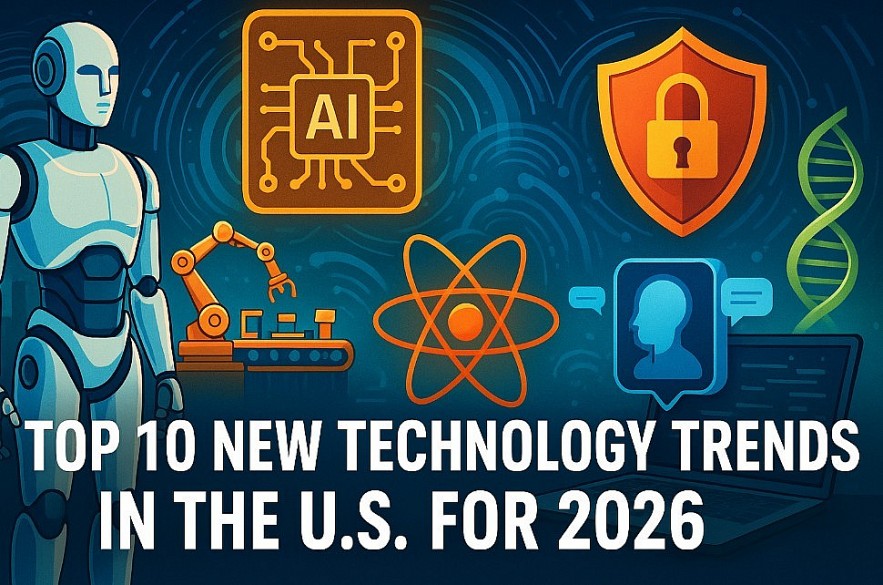
Top 10 New Technology Trends for 2026 — AI, Automation, Robotics and More

 The 2026 U.S. Economy Forecast: Prepare Now or Get Left Behind The 2026 U.S. Economy Forecast: Prepare Now or Get Left Behind |
 Top 10 Places Americans Flee To This Winter — #3 Is Unexpected Top 10 Places Americans Flee To This Winter — #3 Is Unexpected |
 |
| 2026 technology trends |
The Year Technology Stops Being Optional
By 2026, the United States will no longer be in a period of technological experimentation — it will be in a period of technological dependency. Artificial intelligence, automation, robotics, biotechnology, cybersecurity, quantum computing, and advanced energy systems are moving from cutting-edge innovation into everyday infrastructure.
Americans are entering an era where technology does not merely support life; it defines it.
The trends shaping 2026 are bigger than faster processors and smarter devices. They represent structural changes in how Americans work, learn, travel, shop, communicate, and build wealth. Industries will transform, companies will consolidate, and workers will need new skills to stay relevant.
Here are the 10 most important technology trendsin the United States for 2026 — each one a force powerful enough to reshape the decade ahead.1. AI Agents Become America’s New Digital Workforce
In 2026, Americans will not just use AI — they will rely on it.
AI tools evolve into autonomous agents capable of performing multi-step tasks, managing workflows, and making decisions. Instead of “assistants,” they become digital employees.
What AI agents will do in 2026:
-
Draft documents, emails, presentations, and legal summaries
-
Generate video content, ads, animations, and design assets
-
Automate financial planning, budgeting, tax filing
-
Manage e-commerce stores and customer service
-
Handle scheduling, travel, logistics, procurement
-
Perform research at levels comparable to junior analysts
AI becomes a default part of every household and business, dramatically reducing operational costs and making individuals as productive as small teams.
Key industries affected:
-
Marketing
-
Real estate
-
Legal services
-
Finance
-
Healthcare administration
-
Education support
-
IT and software
2026 marks the beginning of the end of “task-based jobs” as AI agents become the new digital labor force.
2. Automation Transforms the American Workplace
Automation is no longer limited to warehouses and factories.
In 2026, nearly every sector — from healthcare to finance to transportation — integrates end-to-end automated systems.
Examples of what’s changing:
-
Hospitals adopt automated check-ins, diagnostics, and patient routing
-
Restaurants use automated cooking machines and robotic food prep
-
Retail stores implement cashier-less shopping at scale
-
Logistics companies use autonomous sorting, routing, and inventory tools
-
Corporate HR systems automate hiring, screening, onboarding
Automation does not eliminate all jobs — but it eliminates many repetitive roles and forces workers to transition into AI-supervised, creativity-based, or technical roles.
The businesses thriving in 2026 will be those that automate early and reinvest the savings into innovation and talent.
3. Robotics Go Mainstream — From Homes to Hospitals
Robotics enters everyday life in ways Americans once considered science fiction.
Key 2026 robotics breakthroughs:
-
Home robots help clean, deliver items, monitor elderly family members
-
Medical robots assist surgeons, deliver medication, and transport supplies
-
Construction robots lay bricks, print houses, and handle dangerous tasks
-
Agricultural robots plant, harvest, monitor crops, and reduce food production costs
-
Industrial robots operate autonomously without constant human supervision
A major shift occurs as robots become affordable and subscription-based.
Families rent robots just like they rent software.
By 2026, robotics is no longer a luxury.
It is an essential component of healthcare, logistics, and home management.
4. Quantum Computing Leaves the Lab and Enters the Market
While true large-scale quantum supremacy is still years away, 2026 is the year quantum computing becomes commercially relevant.
What changes in 2026:
-
Corporations access cloud-based quantum processors
-
Financial firms leverage quantum algorithms for risk modeling
-
Pharmaceutical companies accelerate drug discovery
-
Logistics firms optimize complex routing problems
-
Government agencies experiment with quantum encryption
Why this matters:
Quantum technology gives companies a competitive advantage previously unimaginable. It also introduces new vulnerabilities, requiring quantum-safe cybersecurity solutions.
The U.S. is racing China and the EU for quantum dominance — and 2026 marks the beginning of the commercial quantum era.
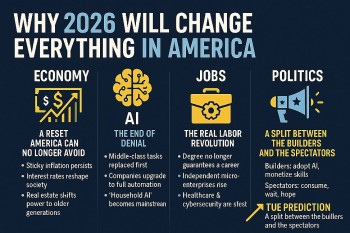 Why 2026 Will Change Everything in America — Economy, AI, Jobs, Politics Why 2026 Will Change Everything in America — Economy, AI, Jobs, Politics 2026 will redefine the United States. From AI automation and a shifting job market to economic recalibration and political upheaval, discover what’s coming next. |
5. Biotech Explodes: Anti-Aging, Gene Editing, and Personalized Medicine
Biotechnology becomes one of the fastest-growing sectors in the U.S. tech ecosystem.
2026 biotech breakthroughs:
-
Gene-editing therapies targeting inherited diseases
-
Personalized medicine based on genetic profiles
-
Anti-aging and longevity treatments entering mainstream clinics
-
Synthetic biology used for materials, energy, and agriculture
-
AI-designed drugs moving from lab to FDA approval faster
Why Americans care:
Healthcare shifts from treating sickness to preventing and reversing disease.
Biotech startups surge, venture capital flows heavily into longevity research, and the FDA adapts to manage a wave of innovative therapies.
2026 becomes a landmark year in the biology-technology merger.
6. Cybersecurity Becomes a National Survival Strategy
With AI generating ultra-realistic deepfakes, automated hacking tools, and real-time social-engineering scripts, cybersecurity becomes the most critical defensive technology of the decade.
Cybersecurity trends defining 2026:
-
AI-powered cyberattacks that learn and adapt autonomously
-
Deepfake scams targeting individuals and corporations
-
Attacks on critical infrastructure: grids, hospitals, transportation
-
Mandatory cybersecurity regulations for businesses
-
Zero-trust systems becoming standard
-
Biometric identity replacing passwords
Companies that fail to secure their systems risk catastrophic losses.
Cybersecurity talent becomes one of the most in-demand career paths in the nation.
In 2026, every company is a tech company — and every tech company is a target.
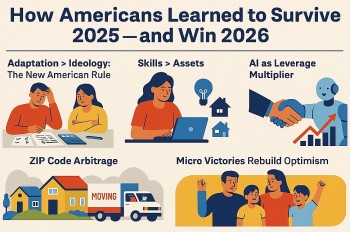 How Americans Learned to Survive 2025 — and Win 2026 How Americans Learned to Survive 2025 — and Win 2026 Learn the new rules of survival in America: mobility, AI adoption, geographic arbitrage, and micro-entrepreneurship. |
7. Web3 Re-Emerges in a More Mature, Utility-Driven Form
After years of hype, collapse, and rebuilding, Web3 returns in 2026 — but without the noise.
Instead of speculation, Web3 finally delivers tangible value.
What Web3 looks like now:
-
Real-world asset tokenization (property, gold, treasury bills)
-
Decentralized identity systems verified with biometrics
-
Enterprise blockchain for logistics, supply chain, and auditing
-
Cross-border payment rails with instant settlement
-
Digital collectibles integrated with entertainment and sports
Crypto becomes boring — and that’s good.
It becomes infrastructure.
Regulation in the U.S. stabilizes, institutional players enter the market, and blockchain becomes invisible plumbing beneath the financial system.
8. Clean Energy Technologies Enter Their Most Important Decade Yet
2026 marks a tipping point for green technology adoption across the U.S.
Not because of climate goals — but because clean energy becomes cheaper than traditional alternatives.
Key trends:
-
Solar and battery storage reach record affordability
-
EV charging networks expand nationwide
-
Hydrogen and nuclear small-modular reactors gain investment
-
Grid modernization accelerates due to extreme weather
-
Home energy systems (solar + battery + heat pumps) surge in adoption
Industry impact:
Energy companies reinvent themselves as technology firms, while U.S. households install more clean energy infrastructure than ever before.
9. AR/VR and Spatial Computing Transform Work, Learning, and Entertainment
Apple Vision Pro, Meta Quest, and enterprise AR platforms reshape how Americans interact with digital environments.
In 2026, spatial computing becomes essential for:
-
corporate training and remote collaboration
-
medical education and surgical simulations
-
virtual tourism and hybrid travel experiences
-
gaming and immersive storytelling
-
interior design and architecture
The U.S. education sector, from universities to trade schools, integrates AR/VR for hands-on learning in virtual environments.
By late 2026, spatial computing becomes as normal as using tablets or laptops.
10. The Rise of Personal AI Ecosystems
The most powerful trend of 2026 is the evolution from a single AI app to a personal AI ecosystem that manages nearly every aspect of life.
What personal AI ecosystems include:
-
AI financial advisor
-
AI fitness and nutrition coach
-
AI therapist for emotional support
-
AI tutor for children and adults
-
AI career strategist
-
AI travel planner
-
AI creative studio for photos, videos, writing
Instead of using 10 different apps, Americans rely on one AI brain that integrates all areas of life, adjusting to preferences, routines, and long-term goals.
Personal AI becomes the new middle-class superpower — giving individuals leverage once reserved for CEOs and large corporations.
Conclusion: 2026 Is the Year Technology Defines Winners and Losers
The U.S. in 2026 won’t be divided by demographics or geography — it will be divided by technological adoption.
People who master AI, automation, cybersecurity, biotech, and clean-energy tools will thrive.
People who resist these changes risk losing economic momentum, professional relevance, and financial security.
2026 is not simply another year.
It is the year Americans decide whether to adapt, accelerate, or fall behind.
In a future where technology moves faster than governments, corporations, and even society, the most powerful strategy is simple:
Learn early. Adopt quickly. Build aggressively.
Those who embrace the 10 trends above will shape the economy, culture, and industries of the next decade.
FAQs
1. Which 2026 technology trend will affect everyday Americans the most?
AI agents and personal AI ecosystems will have the biggest daily impact, changing how people work, manage money, and communicate.
2. Will robots replace all jobs?
No — robots and automation replace tasks, not entire professions. New jobs emerge around oversight, creativity, and system management.
3. Is quantum computing ready for consumers?
Not yet, but businesses will increasingly use cloud-based quantum tools for analytics, drug discovery, and logistics.
4. Is Web3 still relevant in 2026?
Yes, but the hype is gone. Web3 now focuses on real-world utility like digital identity, payments, and asset tokenization.
5. What skills are essential for workers in 2026?
AI literacy, data analysis, cybersecurity basics, critical thinking, creativity, and the ability to work alongside intelligent automation.