Why 2026 Will Change Everything in America — Economy, AI, Jobs, Politics

The Year America Will Stop Pretending Nothing Has Changed
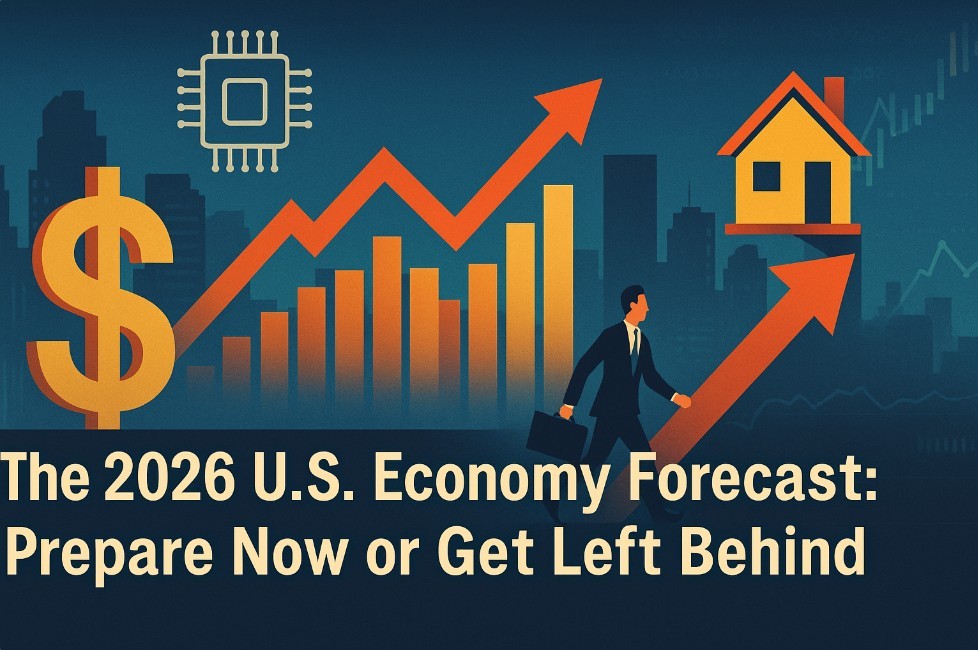
December is always a month of reflection. Americans look back at a year filled with chaos, optimism, crisis, and innovation. But 2025 feels different. It is not merely a year closing — it is the runway toward a transformative 2026, when forces that have been compounding for a decade finally collide:
inflation and interest rates
the AI revolution
structural changes in the job market
political polarization approaching breaking point
demographic shifts and cultural fragmentation
2026 will not be a gentle transition.
It will be a pivot year — one with irreversible effects on how Americans work, invest, vote, and understand power.
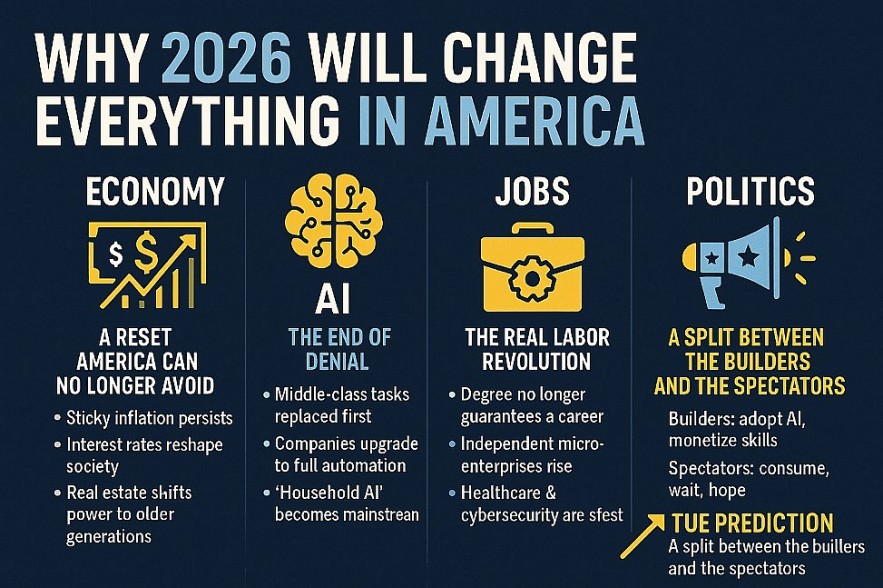 |
| Why 2026 Will Change Everything in America |
The Economy: The Great American Reset
Persistent Inflation Reshapes Daily Life
Even as economists debate technical definitions, ordinary Americans know the truth:
Life is simply more expensive than it has ever been.
Inflation slowed, but prices did not return to their old levels.
A dozen eggs, a gallon of milk, rent, utilities, insurance, and healthcare — everything costs more, permanently.
This leads to three harsh realities:
1. Households are operating at a structural deficit
Even middle-income families struggle to keep up. Holiday purchases, basic groceries, and routine expenses create recurring debt cycles.
2. High interest rates become the norm, not the exception
The era of cheap money is over. Borrowing for homes, cars, education, or business expansion is significantly harder.
3. The cost-of-living crisis impacts emotional stability
Therapists report a surge of economic anxiety, family tension, and burnout. Economic pressure is no longer financial — it is psychological.
The Federal Reserve Holds Immense Power
Every interest-rate decision in 2026 will have political, corporate, and household consequences. The Fed’s influence now extends beyond economics — it shapes:
-
housing stability
-
employment waves
-
national mood
-
political rhetoric
-
investor psychology
In a polarized country, the Fed becomes an institution both revered and blamed — a central actor in America’s unfolding story.
Housing Becomes a Division Between Generations
The U.S. no longer has a unified housing market. It has three Americas:
1. Homeowners with 2–3% pandemic-era mortgages
They hold a golden ticket. They have no incentive to sell, creating a frozen market.
2. Buyers who entered at high rates
Locked into 6–8% mortgages, they feel trapped. Moving is economically impossible.
3. A rising class of permanent renters
Millions of young Americans may never own a home without inheritance.
This shift changes everything:
-
voting behavior
-
family planning
-
migration patterns
-
generational wealth
-
local economies
By 2026, housing will be a national dividing line — not just an asset class.
Artificial Intelligence: From Disruption to Domination
A. AI No Longer “Assists” — It Replaces Tasks at Scale
AI’s first wave affected creative and administrative tasks.
The next wave — arriving fully in 2026 — will reshape entire workflows.
The myth was that AI would eliminate blue-collar jobs first.
The reality is the opposite.
AI’s earliest victims are white-collar workers whose jobs depend on predictable, repetitive tasks:
-
drafting documents
-
writing reports
-
reviewing contracts
-
coding basic systems
-
analyzing spreadsheets
-
scheduling and coordination
These roles do not disappear overnight.
They fade as companies automate process by process.
B. The Rise of Household AI Teams
By 2026, Americans will rely on specialized AI agents for daily life:
-
financial planning
-
tutoring for children
-
legal interpretation of contracts
-
therapy-style emotional support
-
health reminders and appointment scheduling
-
content production for social media or business
-
micro-entrepreneurship assistance
AI becomes less of a tool and more of a digital workforce, quietly replacing tasks once handled by assistants, junior employees, tutors, consultants, freelancers, and even friends.
Families adopting AI early gain unprecedented leverage.
Those ignoring it fall behind rapidly.
C. Corporations Accelerate Toward Full Automation
Businesses in 2026 will shift from experimentation to integration.
Instead of “AI assistants,” companies will deploy:
-
autonomous procurement systems
-
AI-driven HR filtering
-
automated customer support
-
AI market research
-
predictive logistics
-
real-time financial forecasting
-
legal drafting engines
The corporation of 2026 operates on fewer people and more automation, widening the gap between executive leadership and entry-level workers.
Jobs: The New Labor Reality
A. Degrees Lose Exclusivity — Skills and Output Matter More
The labor market in 2026 will be unforgiving to outdated expectations.
Employers value:
-
adaptability
-
workflow automation skills
-
AI literacy
-
problem-solving
-
creativity under pressure
-
measurable output
Traditional credentials matter less.
Proof of ability matters more.
B. The Explosion of One-Person Micro-Enterprises
AI turns individuals into scalable businesses.
A single person can now:
-
create an entire brand
-
produce advertising at scale
-
manage e-commerce
-
run multi-language content
-
design and publish books
-
generate product catalogs
-
automate customer service
-
perform high-level analytics
The gig economy evolves into AI-augmented entrepreneurship.
People no longer ask, “Where do I work?”
They ask, “What can I build?”
C. The Most Stable Jobs Are High-Friction, Not High-Tech
Ironically, fields least threatened by AI are those requiring:
-
physical presence
-
human empathy
-
complex coordination
-
manual repair
-
crisis response
These sectors grow:
1. Healthcare
Nurses, therapists, physical therapists, home-care workers.
2. Cybersecurity
AI gives hackers devastating tools, increasing demand for defense.
3. Robotics maintenance
Autonomous robots still require human specialists.
4. Infrastructure and energy
EV charging, solar, logistics, and grid modernization.
These jobs offer stability in an uncertain decade.
Politics: America Enters a New Age of Fragmentation
A. The Two-Party Narrative No Longer Reflects Reality
The United States is not divided into two political blocs.
It is divided into dozens of cultural tribes:
-
urban progressives
-
rural conservatives
-
young renters
-
older homeowners
-
corporate elites
-
digital nomads
-
single adults
-
religious communities
-
immigrant groups
-
regional identities
-
algorithm-driven subcultures
Political identity is no longer inherited — it is curated.
B. The Media Landscape Fractures Completely
In 2026, political influence focuses less on national networks and more on:
-
YouTube commentators
-
TikTok creators
-
Discord groups
-
independent newsletters
-
micro-influencers
-
regional ethnic media
Narratives spread through viral loops, not official statements.
Truth competes with entertainment.
Influence becomes decentralized and unpredictable.
C. Rising Social Anxiety and the Expanding Security State
Economic stress, cultural fragmentation, misinformation, and polarized rhetoric increase public fear. In response, both parties support stronger:
-
border controls
-
digital surveillance
-
protest restrictions
-
campus oversight
-
intelligence budgets
The national debate shifts from liberty versus authority to stability versus chaos.
Culture: A Society Without a Shared Story
A. The Collapse of the Traditional American Narrative
The promises of the past — affordable homes, predictable careers, stable families — no longer align with modern realities.
This creates emotional instability, especially among younger Americans who feel betrayed by a system built for a different era.
B. Digital Identity Replaces Physical Community
More Americans interact through screens than through real relationships.
Status is measured by:
-
followers
-
engagement
-
aesthetics
-
attention
The result is a society connected online but isolated offline.
Conclusion: 2026 Marks the Beginning of a New American Era
America has endured economic shocks, wars, pandemics, and political crises.
But 2026 represents something unprecedented: multiple structural transformations happening simultaneously.
The economy is reorganizing.
AI is redefining work.
Politics is fragmenting.
Culture is splintering.
Generations are diverging.
The United States entering 2026 is not collapsing — it is reinventing itself.
But reinvention requires adaptation.
The people who embrace change will shape the next America.
The people who resist it will feel left behind.
2026 is the dividing line.
FAQs
1. Why is 2026 considered a transformational year?
Because major economic, technological, and political shifts converge at the same time.
2. How will AI change everyday life in 2026?
AI will manage household tasks, decision-making, and digital labor, becoming a permanent presence in American homes.
3. Will jobs disappear?
Tasks will disappear, not entire job categories. Workers who ignore AI risk losing relevance.
4. Is the middle class shrinking?
Yes — housing, healthcare, and inflation pressures reduce upward mobility.
5. How will politics change?
Influence moves from national institutions to decentralized digital networks.
6. Which careers will thrive?
Healthcare, cybersecurity, robotics maintenance, infrastructure, and AI-literate creative roles.
7. What can individuals do?
Adopt AI tools, build adaptable skills, diversify income, and stay politically informed through reliable sources.
 America in 2025: The Ten Moments That Changed Everything America in 2025: The Ten Moments That Changed Everything Explore the 10 turning points that reshaped America in 2025—from AI and housing to politics and culture—and what these shifts mean for 2026. |
 How Americans Learned to Survive 2025 — and Win 2026 How Americans Learned to Survive 2025 — and Win 2026 Learn the new rules of survival in America: mobility, AI adoption, geographic arbitrage, and micro-entrepreneurship. |
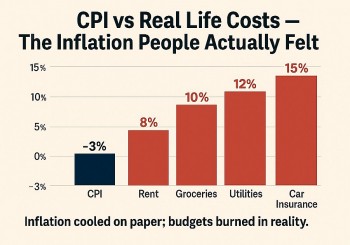 Why Americans Felt Poorer in 2025 — Even After Inflation Fell Why Americans Felt Poorer in 2025 — Even After Inflation Fell Inflation cooled in 2025, but Americans still struggled. Explore how sticky prices, rent, and utilities fueled a real-life economic crisis. |
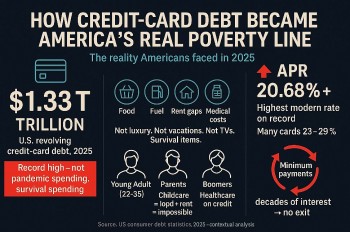 How Credit-Card Debt Became America’s Real Poverty Line How Credit-Card Debt Became America’s Real Poverty Line From groceries to rent, Americans used credit cards to survive in 2025. Explore why interest rates soared and what it means for 2026. |