Why Americans Are Lonelier Than Ever During Christmas — Therapist Explains

 |
| Why do Americans feel lonelier during Christmas despite celebrations |
The Paradox of Holiday Cheer
In movies and commercials, Christmas in America is warm and joyful—cocoa by the fire, hugging family members, twinkling lights, a tree full of presents.
But the real emotional climate is colder. Every December, therapists across the United States report a sharp rise in clients expressing burnout, sadness, resentment, anxiety, or a deep and silent loneliness. Even people surrounded by friends and family feel hollow.
Why is the country lonelier than ever during a holiday designed for togetherness?
We spoke with U.S. therapists, counselors, and mental health researchers. Their answers reveal a cultural problem Americans rarely speak about—one that is economic, digital, psychological, and deeply human.
The American Dream Has Changed — And Christmas Exposes It
A therapist from Boston summed it up simply:
“Christmas is when people realize the gap between the life they have and the life they’re expected to live.”
American culture glorifies milestones:
-
A comfortable home
-
A loving spouse
-
Successful children
-
A stable job
-
Financial independence
But for millions of Americans, December is a mirror reflecting the opposite.
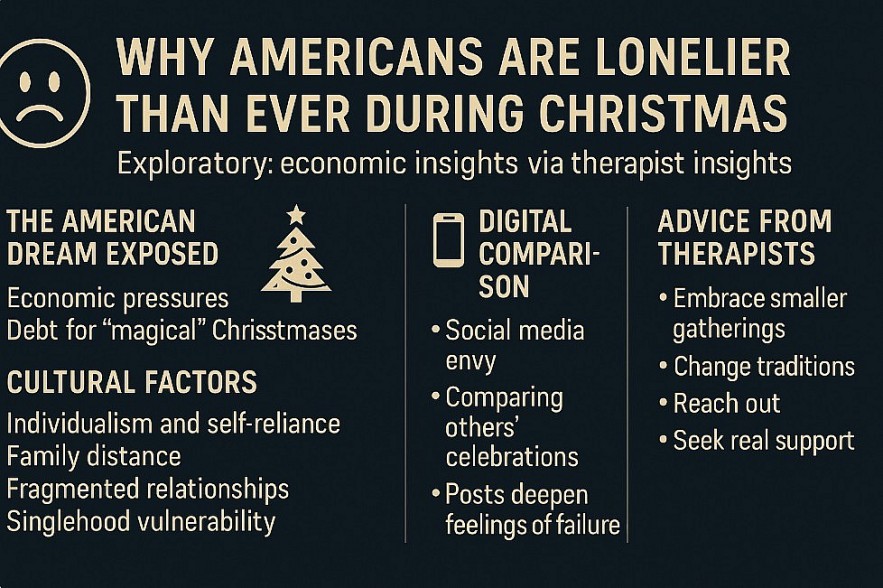
A. Economic pressures amplify emotional isolation
The holiday season is expensive:
-
Gifts
-
Travel
-
Decorations
-
Party hosting
-
Special meals
-
Charitable expectations
Parents take on credit card debt to maintain the illusion of a “magical Christmas.”
Young adults pretend they are doing fine while juggling rent, student loans, and unstable jobs.
For older Americans, retirement savings no longer keep up with inflation.
Loneliness is no longer only a lack of relationships—it is the shame of not keeping up.
This shame grows louder during the holidays.
 |
| Christmas loneliness America |
America’s Culture of Independence Leaves People Emotionally Unprepared
The United States teaches self-sufficiency from childhood:
-
“Work hard and you’ll succeed.”
-
“Don’t depend on others.”
-
“Privacy is dignity.”
-
“You’re responsible for your happiness.”
It sounds empowering, but therapists argue the opposite.
“We trained an entire nation to be emotionally self-reliant,” says therapist L. Hunt.
“Then we wonder why people don’t know how to ask for help.”
In collectivist cultures, older parents live with adult children; holiday gatherings are large, multi-generational events.
In the U.S., many adults spend Christmas:
-
Alone in apartments
-
Across the country from their families
-
In cities where they know no one
-
Working seasonal jobs
-
Recovering from divorce or grief
Even married couples report loneliness because intimacy and proximity are not the same.
Social Media Creates Emotional Comparison, Not Connection
Christmas has become a digital performance.
Americans scroll through:
-
Instagram photos of perfect trees
-
TikTok “gift hauls”
-
YouTube vlogs of luxury holiday trips
-
Couples’ engagement announcements
-
Family matching pajamas
Therapists point out a crucial dynamic:
“The human brain does not measure reality—it measures difference.”
Someone may enjoy a quiet December evening until they see a coworker’s post of a Caribbean vacation or a high school friend buying gifts for four smiling children.
Social media transforms normal life into failure.
The irony? Many of those posts are filtered, staged, or deeply in debt.
But the emotional damage is real.
Comparison makes loneliness louder.
 Christmas Tradition: Oldest Greetings, Vintage Wishes to Keep Ancient Alive Christmas Tradition: Oldest Greetings, Vintage Wishes to Keep Ancient Alive |
Single Americans Are the Most Vulnerable During Christmas
Marriage rates have declined, divorce rates remain high, and dating apps create constant rejection.
Therapists repeatedly highlight December as a dangerous month for people who are:
-
freshly single
-
recently divorced
-
widowed
-
living outside their home state
-
moving after a breakup
-
LGBTQ+ individuals estranged from families
Holiday marketing is built around couples and families.
Everyone else becomes an afterthought.
A 34-year-old client told a therapist:
“I don’t want gifts. I just want someone to call me first.”
Gift exchanges do not replace intimacy.
Decorations do not replace belonging.
Digital interactions do not replace human touch.
Invisible Grief: Those Who Lost Someone Are Expected to “Be Strong”
Christmas is a grief amplifier.
Americans who have lost:
-
a spouse
-
a child
-
a sibling
-
a parent
-
a best friend
-
a pet
…often experience unbearable emotional pressure.
The empty seat at the dinner table becomes an emotional crater.
Grief does not operate on a calendar.
People do not wake up on December 24th suddenly healed.
Yet U.S. culture is uncomfortable with vulnerability.
Friends say:
-
“They’re in a better place.”
-
“You need to move on.”
-
“You should be grateful.”
-
“Just think positive.”
Therapists say none of this helps.
People do not need advice.
They need permission to feel.
Christmas Is About Family — But Modern Families Are Fragmented
Many Americans do not talk to their parents or siblings.
The reasons are endless:
-
political disagreements
-
financial disputes
-
religious differences
-
identity conflicts
-
divorce
-
childhood trauma
-
abuse
-
addiction
-
neglect
Therapists point out something uncomfortable:
“We assume every family wants to celebrate together.
Many families celebrate the day they escaped each other.”
Holiday gatherings are emotionally loaded:
-
old wounds resurface
-
unresolved apologies collide
-
arguments disguised as jokes
-
alcohol removes social filters
People return home hoping for peace,
only to re-experience the environments that hurt them.
This makes loneliness safer than connection.
The American Work Culture Never Stops
Real rest is a privilege—not a right.
Millions work through Christmas:
-
nurses
-
retail workers
-
airline crews
-
police
-
hospitality staff
-
gig delivery drivers
-
warehouse workers
Even white-collar workers answer Slack messages at airports.
Americans are taught to celebrate “hustle,”
but no one tells them how to recover.
A therapist from Seattle explained:
“Loneliness is often just exhaustion with no one to share it with.”
Work replaces community, and when the work stops, people realize how little is left.
Digital Connection Doesn’t Teach Emotional Skills
Americans communicate through:
-
emojis
-
memes
-
short videos
-
voice notes
-
disappearing messages
-
dating app prompts
This creates contact, not intimacy.
Therapists emphasize:
“We are losing the ability to feel safe with each other.”
People can text all day but panic when asked:
-
“How are you really?”
-
“What do you need?”
-
“What are you afraid of?”
The Christmas season becomes a test.
Many fail it silently.
The Psychological Bomb: Expectations vs. Reality
Christmas demands joy.
Loneliness despises performance.
When people feel sad in March, it is tolerable.
When they feel sad in December, they think:
-
“What is wrong with me?”
-
“Why am I alone?”
-
“Everyone else is happy.”
This cognitive dissonance creates despair.
In therapy offices, people confess:
-
They dislike Christmas music.
-
They dread family gatherings.
-
They panic at gift exchanges.
-
They fear going home.
-
They feel guilty for not being “festive.”
The holiday becomes a psychological deadline—
a scoreboard of emotional failure.
How to Cope — Therapist-Approved Guidance
Therapy is not about “thinking positive.”
It is about realistic emotional safety.
A. Shrink the holiday
You do not owe the world a cinematic Christmas.
-
Celebrate smaller
-
Change traditions
-
Start new ones
-
Invite a friend instead of family
-
Order pizza, not turkey
-
Watch movies, not Instagram
B. Treat loneliness like hunger
Loneliness is a biological signal.
It means you need connection, not perfection.
Start with:
-
one conversation
-
one call
-
one meetup
-
one shared activity
C. Don’t compare, curate
Mute influencers.
Unfollow people who trigger insecurity.
Turn off notifications.
You don’t owe the internet your mental health.
D. Seek real support
Therapy, group counseling, grief circles, church communities, volunteer work—
anything that provides human presence.
You do not need to be “fixed.”
You need to be witnessed.
Conclusion: Christmas Doesn’t Heal Loneliness — It Reveals It
The United States is not lonely because it lacks people.
It is lonely because it lacks permission to need each other.
Therapists across America agree:
-
Loneliness is not weakness.
-
Connection is not a luxury.
-
Vulnerability is not failure.
Many Americans spend Christmas feeling like outsiders in their own lives.
They scroll, they smile, they compose holiday captions—
but inside, they are asking a simple question:
“Is anyone thinking about me?”
Human beings, in every culture and every season, long for the same thing:
to be seen, to be heard, and to matter to someone.
Christmas will not fix that.
But it can remind us what needs healing.
FAQs
1. Why do people feel lonely even when surrounded by family?
Because emotional connection requires trust and safety, not physical proximity or shared blood.
2. Do social media platforms make loneliness worse?
Yes —constant comparison and curated perfection distort reality and heighten insecurities.
3. How can someone cope with grief during holidays?
Honor the loss instead of suppressing it: rituals, memories, lighting a candle, or speaking about the person can help.
4. Why do therapists say “shrink the holiday”?
Because oversized expectations create pressure. Smaller celebrations reduce stress and reclaim meaning.
5. Is loneliness a sign of depression?
Not always. Loneliness is a biological need for human connection—like hunger or thirst. Chronic loneliness, however, can lead to depression.
6. What are practical ways to build connection?
Volunteer, join local groups, attend community events, invite friends to simple activities, or seek therapy.
 Why are there no NHL games on Christmas Eve or Day? Why are there no NHL games on Christmas Eve or Day? The NHL typically avoids scheduling games on Christmas Eve and Christmas Day |
 The Evolution of Christmas Greetings in the Digital Age The Evolution of Christmas Greetings in the Digital Age As we dive into this fascinating transition, we’ll explore how Christmas greetings have transformed in the digital age, touching on e-cards, social media messages, creative ... |
 Unique Christmas Greetings from Around the World Unique Christmas Greetings from Around the World From Germany’s “Frohe Weihnachten” to France’s “Joyeux Noël,” these unique greetings reflect the rich diversity of traditions and values that make each culture special. Let’s ... |
 What is 'Merry Christmas' and The Oldest Christmas Greetings in History What is 'Merry Christmas' and The Oldest Christmas Greetings in History In this article, we explore the origins of these greetings, the history of the phrase “Merry Christmas,” ancient Christmas traditions reflected in messages, and the ... |