Snow Days vs. Remote Learning: Which States Still Let Kids Have a Day Off?

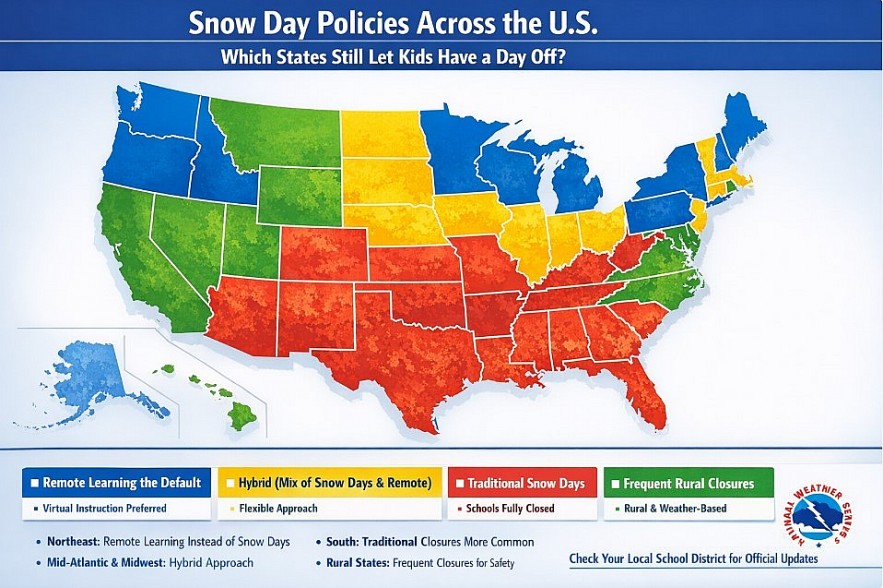 |
| State-by-State Snow Day Policy Map: Where Schools Still Close — and Where Kids Log In |
As winter storms continue to disrupt large parts of the United States, parents are discovering that where you live now matters more than how much snow falls when it comes to school closures.
Across the country, school districts have taken very different approaches to snow days since the COVID-19 pandemic. Some states still allow — and even prioritize — traditional snow days. Others have quietly replaced them with remote learning, even during major winter storms.
Here’s how policies break down by region, why they differ, and what families should realistically expect going forward.
Read more:
- Will Schools Close? What Families in Storm-Hit States Need to Know
- Snow Day or Remote Learning? What Parents Should Really Expect During Major Winter Storms
- Snow Days vs. Remote Learning in the U.S.: How the 10 Largest States Handle School Closures
- Snow Days vs. Remote Learning: How School Closures Work Across Different U.S. States
States That Still Commonly Allow Traditional Snow Days
In several parts of the country, full school closures remain the norm during winter storms, especially where ice and power outages pose serious safety risks.
Southern and Ice-Prone States
States such as Georgia, Texas, Tennessee, and Alabama are more likely to cancel school outright during winter weather.
Why?
-
Ice storms are more dangerous than snow
-
Power outages are common and can last days
-
Many areas lack extensive snow and ice removal infrastructure
-
Remote learning is often impractical without reliable electricity
In these states, districts frequently determine that student safety outweighs instructional continuity, making true snow days more common.
 |
| Which States Still Let Kids Have a Day Off |
States That Mostly Use Remote Learning Instead of Snow Days
In contrast, many snow-accustomed northern states now rely heavily on virtual instruction.
Northeast and Upper Midwest
States including New York, Massachusetts, Pennsylvania, Michigan, and Minnesota have widely adopted remote snow days.
Large districts argue that:
-
Roads can often be cleared quickly
-
Power grids are more reliable
-
Remote systems are already in place
-
Virtual days prevent extending the school year
New York City, for example, has publicly confirmed that snow days have been replaced by remote learning, even during major storms.
States With Mixed or Hybrid Policies
Some states fall in between, allowing districts flexibility.
Mid-Atlantic and Parts of the Midwest
In Maryland, Virginia, Ohio, and Illinois, policies often depend on:
-
Whether snow or ice is expected
-
Urban vs. rural district infrastructure
-
Duration of the storm
-
Overnight refreezing risk
Many districts use a limited number of “Flexible Instruction Days” and still preserve one or two traditional snow days per year.
Why Policies Differ So Much by State
The divide is not political or arbitrary. It is largely logistical.
School officials typically weigh:
-
Bus safety on untreated roads
-
Likelihood of power and internet outages
-
Ability to clear sidewalks and secondary streets
-
Staff availability and commute conditions
Guidance from the National Weather Service often informs decisions, but local infrastructure ultimately determines outcomes.
Are Snow Days Disappearing Nationwide?
Not entirely — but they are becoming less common, especially in large urban districts.
Many school boards now:
-
Cap the number of traditional snow days
-
Convert additional closures into remote learning
-
Face growing parent pushback
Some districts have begun reconsidering policies after families reported that remote snow days during power outages were unworkable.
What Parents Should Expect Going Forward
For most families, the safest assumption is this:
-
Northern states: Expect remote learning first
-
Southern states: Expect full closures during ice storms
-
Mixed states: Expect late decisions and hybrid approaches
Parents are increasingly advised to prepare for remote learning even on heavy snow days, unless their district explicitly announces a closure.
The Bottom Line
Snow days are no longer universal — they are regional.
While some states still give students a true day off during winter storms, others have effectively phased snow days out in favor of virtual instruction. Until national standards emerge, parents should look less at snowfall totals and more at local policy and infrastructure to know what to expect.